
Hızlı Git
We’ve moved on to another project review piece; this time our focus is not a school building, but a play landscape embedded right in the heart of the city, tucked into a residential fabric: Wired Scape. What makes projects like this interesting is that they stop being “just a playground for children” and start turning into a neighborhood-scale public magnet. In a way, they set up a small urban stage—one where children, parents, teenagers, and older residents all end up sharing the same ground, even if only briefly, throughout the day. Wired Scape seems to aim exactly for that: by bringing together nature metaphors, fluid geometries, and the idea of open-ended play, it tries to establish a public destination that speaks to users of all ages.

Wired Scape is located within a residential district of Guangzhou, China, and is presented as a designed and built project by 100architects (Shanghai). The site area is 1,550 square meters. The documentation is also shared transparently—down to the design team and project management team—which makes it easier to read the project not merely as a “visual show,” but as a real practice of construction and coordination.
Project Focus and Significance
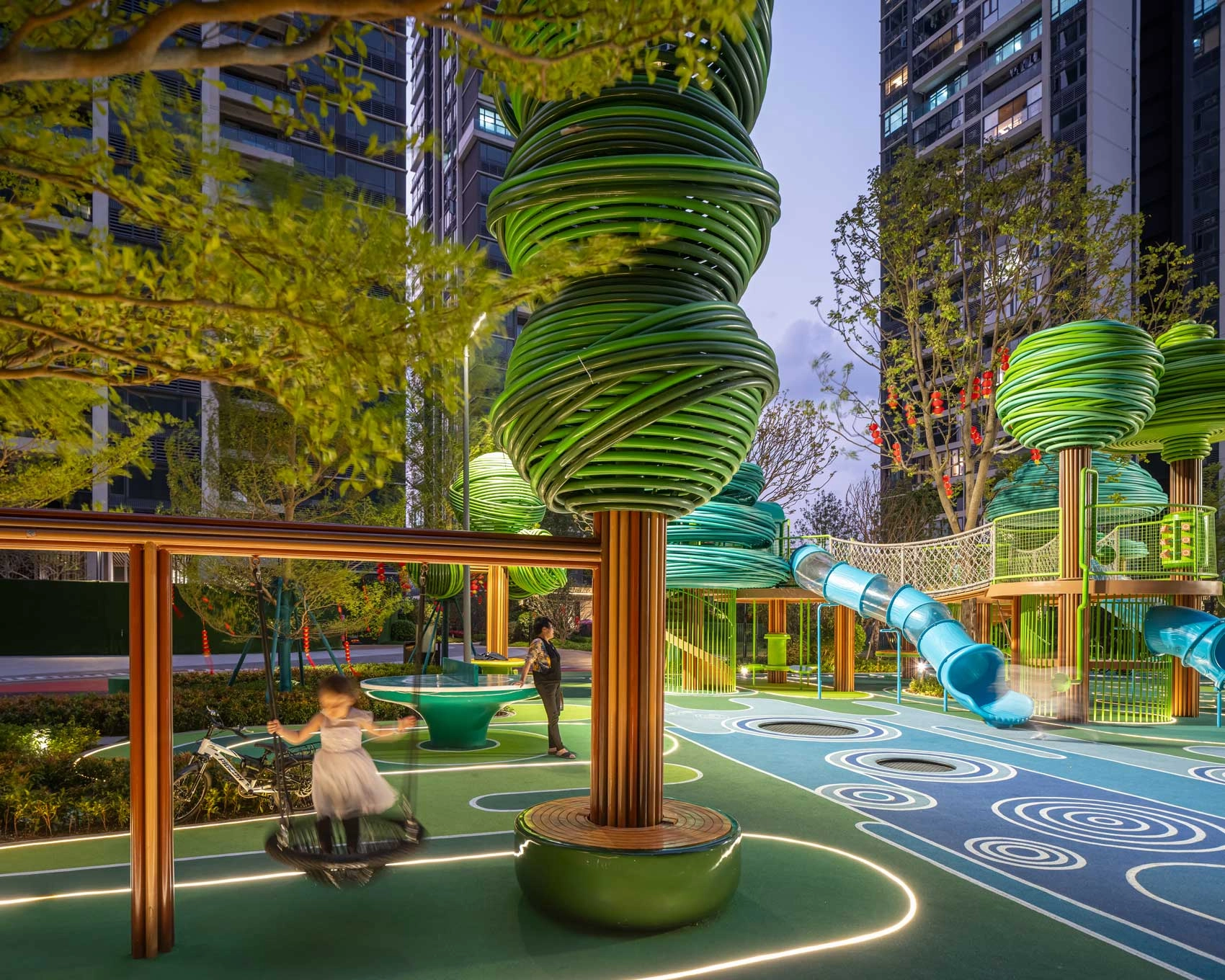
Wired Scape’s main agenda is clearly to break away from conventional playground templates (a few standard swings, a slide, rubber surfacing, fenced around the edges). Here, play is not treated as the sum of individual pieces of equipment; it is approached more like a topography-adjacent “field composition.” Two primary sources of inspiration are highlighted: forest and stream. These themes are not recreated through literal landscape imitation; instead, they are reinterpreted through abstract geometries and sculptural forms. The sense of “forest” is built through the tree-like structures gathered at the center, while the sense of “water” is expressed through the curving, colorful flow lines embedded in the ground plane.
The urban value of this approach becomes clearer at a specific point: children’s play areas often end up either overly controlled or overly sterile. Yet a child’s ability to “read” a space, generate their own routes, and make small decisions while moving from one place to another (height, bridges, shade, openness, movement) can be developmentally meaningful. Wired Scape’s emphasis on open-ended play suggests an intention to shape an environment that triggers motor and cognitive skills at the same time; actions like climbing, exploring, jumping, and sliding are deliberately foregrounded.
Design Features and Spatial Composition
The most iconic element of the project is the set of four sculptural “tree” structures gathered at the heart of the site. These structures are described as being formed by pipes spiraling around a central core, producing tactile, woven spheres—volumes that also resemble (almost delicious) candies. What’s compelling here is that the structure functions both as play equipment and as a canopy. In other words, it is not a single-purpose object; it generates vertical play, shade, and a strong spatial “focus” at once. Moreover, by connecting these four structures with suspension bridges, the project creates layers—shifting the experience from a flat park surface into a multi-level landscape of exploration.
The ground plane, meanwhile, works like a large pattern system that holds the project together: curving lines “stitch” different zones into one another. These lines are not only a visual graphic; they also act as a wayfinding language, offering hints about circulation and pauses. In some places, the lines open into a small plaza; in others, they lead to a resting platform; in others, they intensify as you approach a play element. This kind of “spatial storytelling through the ground” is especially powerful for children, because a child often reads space not through signage but through surface cues and the feeling of edges.
Right in front of this central composition, there is a lowered “sunken plaza” definition—described in the text through metaphors like a “playful amphitheater” or a “depressed lake.” This move introduces something we rarely see in the city: a small social bowl inside a playground, with potential for gathering and performance. For children, this bowl becomes a micro-topography where even simple movements like running and rolling feel more exciting; for adults, it offers a place to sit, observe, wait, and strike up a short conversation.
User Experience: The Idea of Multi-Generational Play
Wired Scape’s ambition is not aimed only at children; it tries to produce a multi-generational environment. For children, an active play repertoire is considered: climbing, jumping, sliding, and exploration. For parents and caregivers, the narrative mentions shaded seating areas and clear sightlines—valuable in terms of “comfortable supervision,” an issue often neglected in playgrounds. Because in a park where the adult is not physically comfortable, supervision tends to swing either toward over-intervention or toward complete detachment; neither outcome is ideal for the child.
The project’s more “urban” side appears in the way it also attracts young adults: sculptural aesthetics, photogenic details, and social appeal. There are two edges to this. On one hand, it can increase a sense of ownership over the public space and give the neighborhood an identity. On the other hand, crowds drawn purely by visual attraction may reduce children’s play comfort. The balance here is shaped by zoning and the relationship between seating and circulation. The project text highlights multiple entry points, generous shading, and different functional islands; this can function as a strategy that makes it easier for people to disperse even during busy moments.
Amenity Diversity and the Play Repertoire
The site also includes classic play elements: swings, see-saws, spring riders, carousel-like spinning components, and even a round table-tennis table. This diversity matters because not every child is drawn to the same type of play. Some children love climbing; some seek rhythmic motion (swings); some enjoy social competition (table tennis); and some participate in play simply by watching. It is also noted that sculptural seating elements are treated not just as “benches,” but as part of the play experience; I find this valuable, because seating is not merely passive furniture—sometimes for a child it becomes a boundary, sometimes a stage, sometimes a surface to hide behind.
At this point, a small caveat is worth adding: a large number of amenities can make maintenance and safety management more difficult. Each new element adds another line to the periodic inspection checklist. Still, the fact that 100architects frames this project at the scale of a “neighborhood intervention” likely implies that management capacity is also considered as part of the design. In projects like this, real sustainability is often hidden not only in materials, but in the operational routine.
Night Use and Transformation Through Light
One of the striking aspects of Wired Scape is its night scenario. The narrative describes decorative lighting embedded into surfaces and the ground, following selected lines and turning the site into a “glowing landscape.” This is not only an aesthetic gesture; it also becomes a layer that shapes perceptions of safety in the evening. Where the light concentrates and where it falls quiet directly changes how children and adults use the space after dark. Of course, the critical city-scale question here is: has the lighting been resolved without producing light pollution or disturbing nearby housing? It is hard to read this definitively from the text, but the emphasis on “embedded, decorative lighting that follows selected lines” suggests an intention toward a more controlled lighting language.
Ecological Integration and the Question of “Naturalness”
This project calls nature not through plant density, but mostly through nature metaphor and biomorphic composition. Here, the forest is not the trees themselves so much as a sculptural re-production of the idea of “tree.” Flowing water is represented without an actual water element, through the language of movement on the ground. The strength of this approach may be a reduced maintenance burden and a more stable, four-season spatial performance. The weakness is that children’s contact with real ecological processes can remain limited. If there is a real canopy of shade trees nearby, small biological islands where soil contact is possible, or at least a “nature observation” corner, the project could establish a much more balanced child–nature relationship. The 100architects text includes expressions suggesting that the structures wrap around existing trees and create tactile volumes, which hints that existing trees have been incorporated into the design.
In my own reading practice, I like to move discussions of projects like this beyond the “hard surface vs. soft surface” binary and instead talk through “how a child perceives nature.” Sometimes a child’s sense of nature does not come only from stepping on soil; it can also come from hearing how wind produces sound in a void, noticing how shadows shift through the day, and touching different textures. Since Wired Scape strongly emphasizes tactile richness, it carries a powerful potential for multi-sensory experience.
