
Hızlı Git
Today, let’s take a short break from everything, from all that rushing around and those tiring routines. I want us to step one pace back from the city’s noise and listen to nature’s healing quiet and the whisper of green. Because behind those familiar views we lift our heads to see, a massive time tunnel is hidden—one that pushes the limits of our imagination.
A Journey Through Time
Have you ever paused under a magnolia tree and really looked at it?
Not just saying “how beautifully it bloomed”… but a little more carefully?
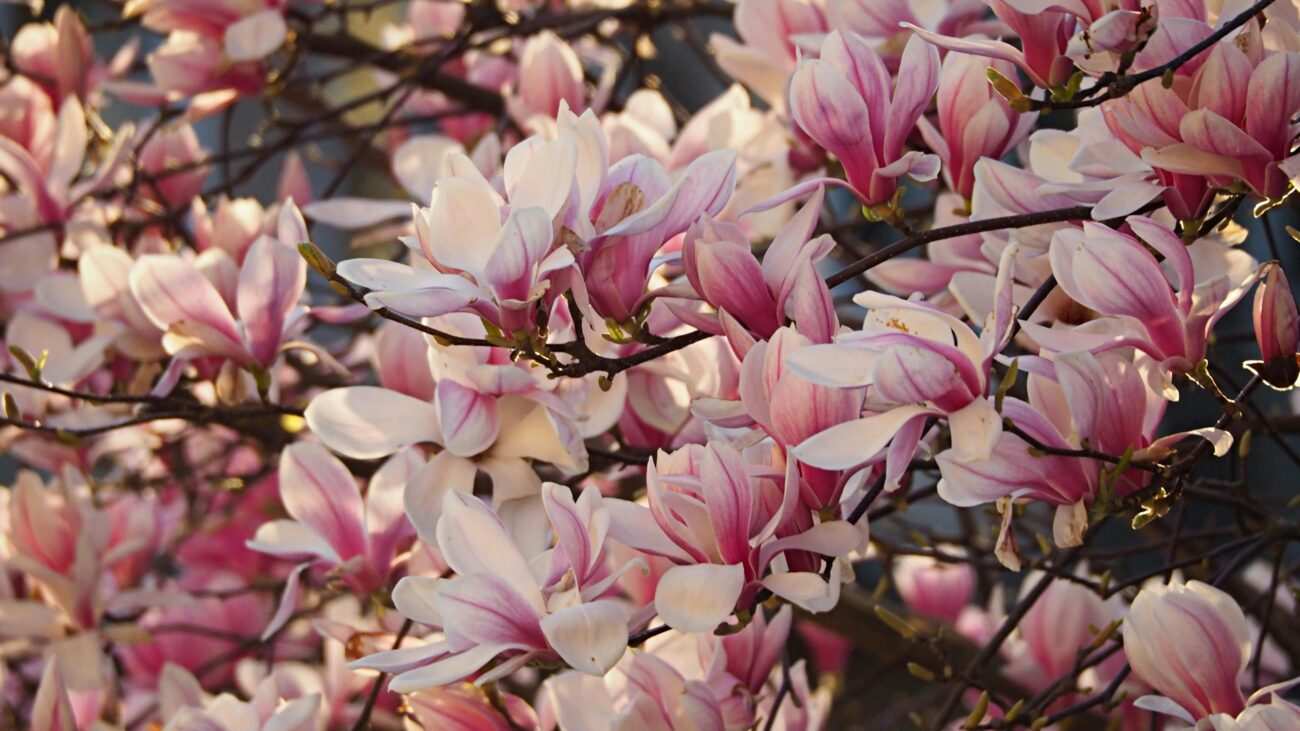
Those large, almost porcelain-like flowers…
Thick and resilient textures…
A feeling as if it belongs not to today, but to another time…
This strange familiarity is not for nothing. Magnolia is far more than an elegant ornament of modern gardens. It is a lineage that has persisted on Earth since the ages when dinosaurs roamed.
Around 95 million years ago, when there were no bees yet, flowering plants were only just stepping onto the stage. Magnolia was one of the oldest actors in that scene. That showy bloom we meet today in a park, along a campus path, or in a home garden is, in fact, a living witness that has reached us from the early pages of evolutionary history.
Maybe that is why, when we look at a magnolia, a feeling appears inside us that is hard to explain. We are not only looking at it. We are witnessing the depth of time. Because magnolia carries the quiet but stubborn memory of the past.
Fossil records prove that the ancestors of these plants emerged in periods when the climate in the Northern Hemisphere was much warmer and then spread across a wide geography. As a member of the Magnoliid group—often considered among the ancestral branches of modern flowering plants—magnolias are one of the oldest representatives of plant evolution.
So how did this delicate flower survive and reach today while the world around it collapsed and rebuilt itself again and again, while ice ages froze continents?
Before Bees: Evolution Shaped for Beetles

The most striking truth in magnolia’s story begins in that lonely period when bees had not yet appeared on the world stage. With the most faithful friends of flowers absent, magnolias had to develop their pollination strategies according to the creatures available at the time: beetles. Because of this primitive partnership, magnolia flowers do not produce the nectar that attracts bees. Instead, they offer beetles protein-rich pollen or sugary secretions. Their thick and fleshy petals are a near-perfect armor developed to prevent those large and clumsy insects of the time from chewing and damaging the flower.
Tepals: An Early Form of Flower Evolution
When you look at a modern flower, you usually see green sepals and colorful petals. But magnolias belong to an ancient period when this separation had not yet formed. The floral envelope of magnolias consists of parts that carry the characteristics of both structures together and are called tepals. In addition, the reproductive organs of the flower are arranged not in rings as in modern flowers, but in a spiral pattern on a cone-like axis—one of the clearest signs of their primitive nature that branched off before the familiar monocot or dicot lines.

Photo: Drew Beamer
Reading Temporal Landscapes with Magnolia
The current distribution of magnolias is like a map that tells us about continental movement and climate history. Fossil records show that magnolias once lived in a broad, continuous forest belt covering North America, Europe, and Asia. But as global cooling and ice ages wiped out the European species, magnolias survived only in East Asia and the Americas, turning into disconnected populations.
In landscape design, the magnolia tree—with its evergreen leaves and enormous flowers—creates the effect of a “natural sculpture,” adding an aristocratic stance and a timeless depth to gardens.
Memory, Resilience, and Design

Photo: Micheile Henderson
The magnolia tree is not only a biological being; it is also a powerful symbol of cultural memory. In China it represents purity and “Yin” energy, in Japan nobility, and in the American South a certain stance of character. It also carries a medicinal memory. Its bark and buds have been used for thousands of years in traditional medicine as calming and healing agents. Able to withstand harsh climatic conditions and air pollution, and able to keep its form without needing pruning, magnolia holds both fragility and a “steel-like” resilience within the same trunk—one of nature’s most successful designs.
Now let’s return to today, perhaps to the tree in that park near your home. When you pause beside a magnolia tree and breathe in that magnificent fragrance, you will actually be smelling not just a flower, but millions of years of history, an evolutionary victory, and nature’s resilience. It is one of the most beautiful legacies left to us from the world of dinosaurs.
The next time you touch a magnolia leaf, feel a 95-million-year-old secret pulsing at your fingertips.


