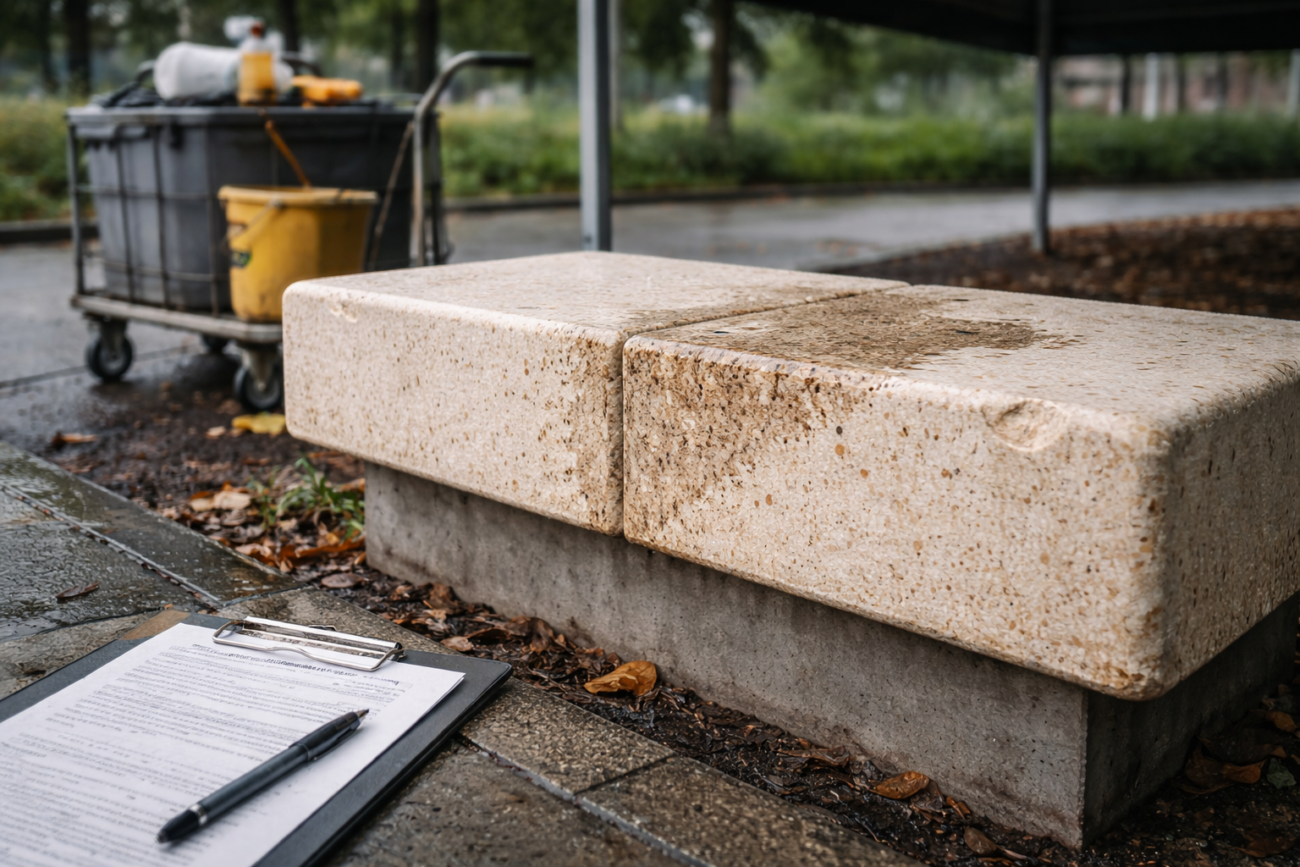

Hızlı Git
Spot: Mycelium composites are a family of materials that doesn’t fit into the easy shortcut of “everything natural is good.” In the right place they can be genuinely promising; in the wrong place they can turn into something you keep wrestling with.
At a fair once, I picked up a small panel sitting at the edge of a booth. At first touch it felt like “plastic foam”: light, firm, with a matte surface. Then I ran my finger along the edge and the feeling shifted; the cross-section had a tiny fibrous weave, like compressed straw held together not by glue but by… something else. When I brought it closer, there was a faint trace in the smell too—something like damp soil mixed with mushroom. When I pressed the edge it didn’t snap with a “click.” It compressed and came back, yet it also left a thin crack line at the same time. A strange question landed in my head: “Is this alive?” “Alive” might be a little romantic, but it clearly wasn’t behaving like a completely dead material either. It looked like plastic, but it wasn’t plastic; more like biology that had learned how to resemble plastic.

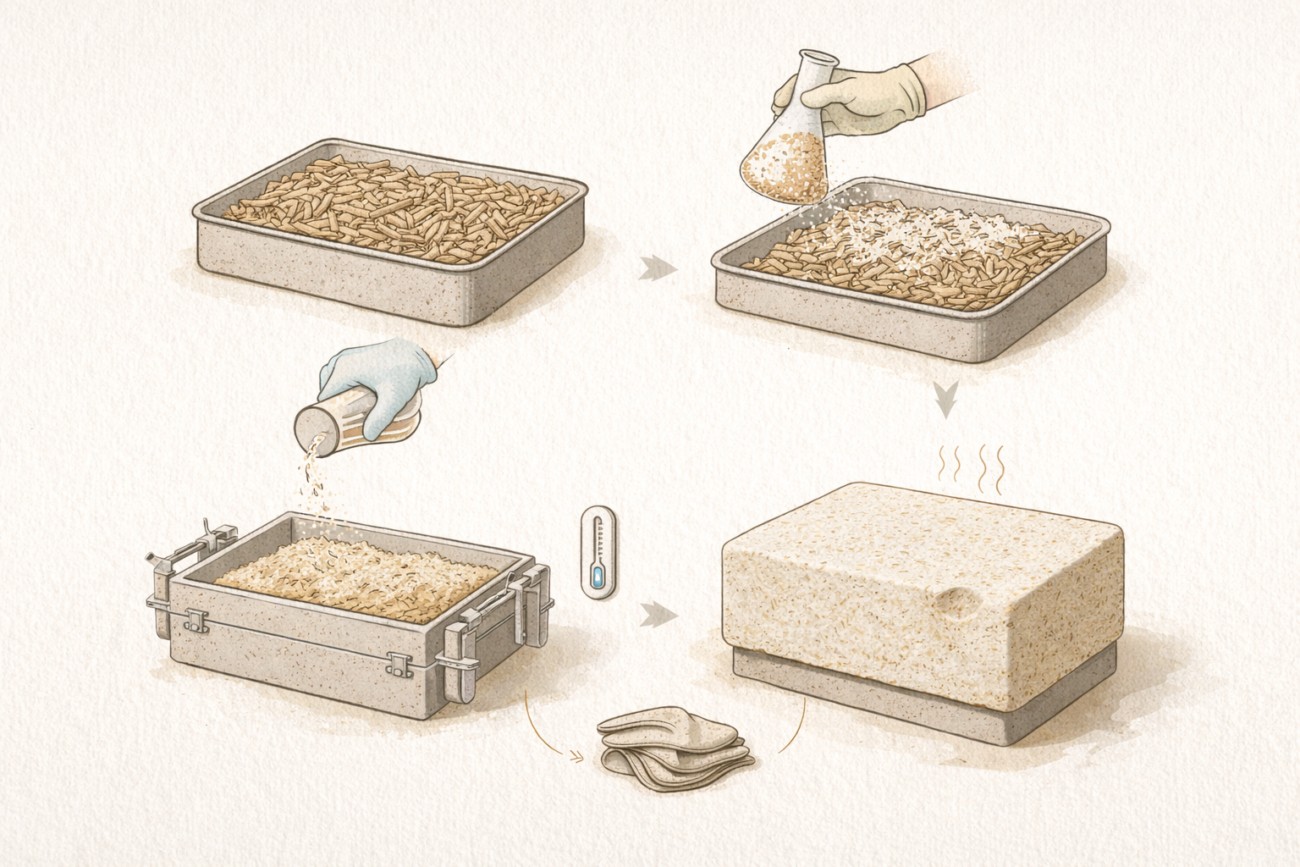
What we call a mycelium-based composite is, in short, using the underground network of fungi (mycelium) as a kind of natural binder to stitch agricultural waste and fibrous residual materials together. Mycelium plays the role of an “adhesive” here: straw, sawdust, hemp shives, coffee grounds—whatever you have—mycelium grows through them and weaves a network. Then that growth is stopped, typically by drying, heating, or a similar process. In everyday language: the material seems to “weave itself” inside a mold.
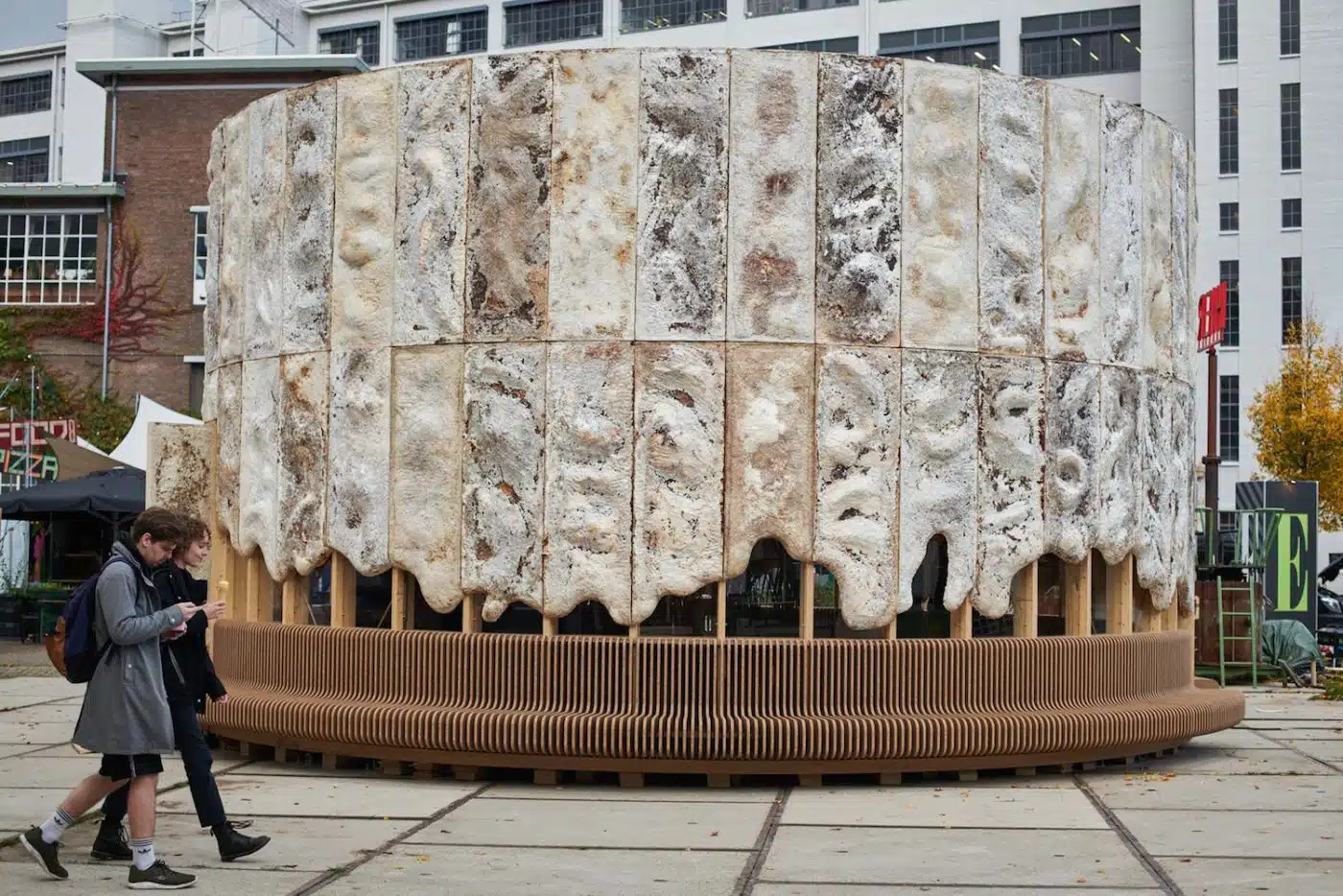
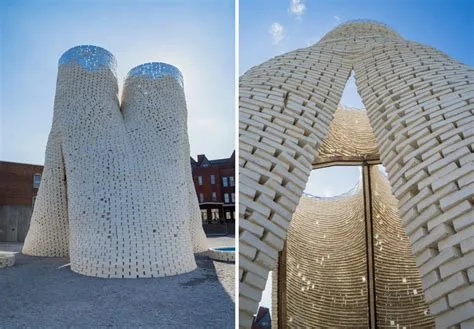
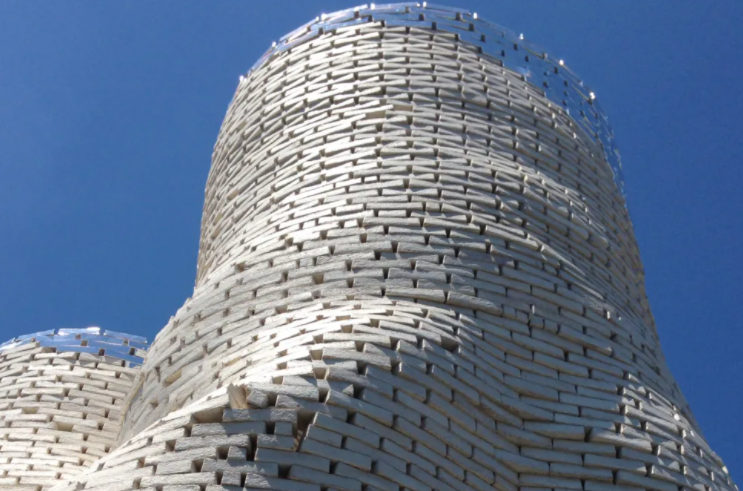
Until a few years ago, this story mostly circulated in pavilions and design fairs. Visually it is strong; it carries a “natural yet futuristic” aesthetic, and it is easy to narrate: a material born from waste, compostable surface, low energy… But over the last two years, the tone feels like it has shifted. The fair-object vibe still exists, yet it no longer feels sufficient on its own; people are asking for more “performance.” What does it do in fire? Does it absorb sound? Does it change when it sees humidity? Can production be standardized? That question set pushes the material from being a trendy keyword toward real project tables. The literature shows a similar drift: production parameters, inspection and standardization, and building physics (heat–moisture behavior, strength, fire, and acoustics) are being discussed more intensely.
Where does mycelium work, and where does it not?
In landscape practice—especially in the public realm—this question strips away romance quickly. Because landscape has “real-life criteria” that can be unforgiving: vandalism, maintenance budgets (or the lack of them), freeze–thaw cycles, UV, rain, warranties, procurement units, supply chains. Good intentions don’t carry a material on site by themselves.
Plastic feel, organic reality
Mycelium composites can often have a lightness and texture reminiscent of “plastic foam.” Sometimes there is a velvety matte surface; in the cross-section, a fibrous porosity. That porosity looks like a good thing—because it opens doors to lightness and sound absorption—but the same porosity also likes water, holds dirt, and can carry a risk of “denting and staying dented” under impact.
A concrete detail: on one prototype, when I pressed my nail into the surface, a small mark remained. It wasn’t like plastic; it was more like the crust of dry bread—slightly yielding. On another piece, when I rubbed the edge as if sanding, a fine dust appeared; fibers broke and drifted away.
Mycelium composite can partially replace materials in scenarios like: low-load interior surfaces, exhibition elements, decorative partitions, acoustic panels, temporary pavilion skins, packaging-like protective parts… But replacing these is difficult: outdoor seating surfaces that take constant hits, façade claddings that will stay under sun and rain for years, and standardized public furnishings where we expect consistent performance for a long time.
Let’s put two clear sentences down. In an interior environment with controlled humidity, as a temporary exhibition or pavilion element, mycelium composite can make sense; because lightness and form freedom increase installation speed.
And another: if used as a bench surface in a heavily used urban park exposed to rain–sun cycles, it will likely cause headaches; because water, UV, and impact arrive at once, and the material’s “delicate” side becomes dominant.
Water, UV, impact: the material’s three-part exam
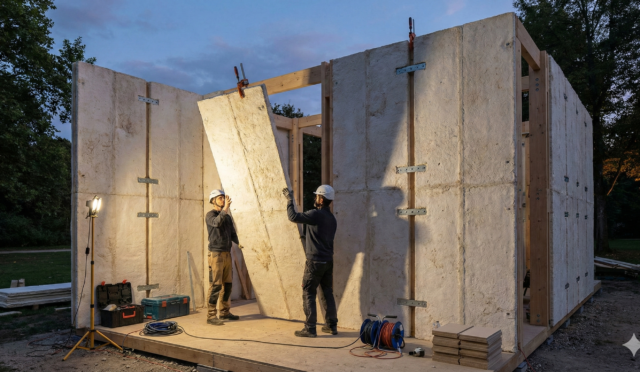
Water is one of the most critical topics. Mycelium composites can be prone to water absorption; this raises both the risk of swelling or deformation and the tendency for the surface to stain. Once, a few drops fell on a small sample: the drop darkened the surface instantly and left a mark when it dried. Even indoors, that creates the question “How will this be cleaned?” Outdoors, water is not just water; rain can be acidic, it carries mud, and freeze–thaw cycles can enlarge microcracks.
UV is more subtle. Sunlight changes the color of organic materials; with mycelium composites, the possibility of fading or turning into a chalky texture is often discussed. Meaning the material might lose its first-day beautiful matte look and become more “dusty.” In a landscape project, this transformation affects not only aesthetics but also perceived hygiene; municipal teams might look at it and ask, “Is this dirt, or is this just the material now?”
Impact and intensive use… here the material can oscillate between two behaviors: sometimes it dents and recovers; sometimes it forms a fibrous fracture line. A hard kick, a bicycle bump, a skateboard hit, children stepping on the same spot repeatedly—these are daily realities outdoors. If mycelium composite is not reinforced by high-density pressing, coatings, or similar processes, it can struggle to make peace with that daily life.
The “biodegradation” side is also double-edged. By definition, being able to break down under appropriate conditions is described as a positive feature; but in the public realm, this can sometimes mean “limited service life.” The material’s life cycle needs to match the project’s expected life. In landscape we often assume 10–15 years or more; in some scenarios, mycelium composite may not carry that expectation.
Is it suitable for outdoor furniture? The honest answer is: conditionally. In a semi-open space that is covered, does not receive rain, and is not in direct sun; supported with an appropriate protective layer (a bio-based coating, something water-repellent yet breathable), and with modular part replacement planned, limited use could be considered. But in open areas—especially where vandalism and intensive use risks are high—it usually remains an “experiment”; it struggles to become long-term, standardized urban furniture.
Third clear sentence: In an interior space with an acoustic problem (for example, an activity hall in a youth center), as a wall or ceiling surface that will not take impact, a mycelium-based panel can work; because its porous structure can “swallow” part of the sound energy.
Fire behavior: speaking without saying “non-combustible”
One claim we often hear about mycelium composites is “fire resistance.” Here we need to be careful with language: saying “non-combustible” is risky both technically and ethically. Fire behavior varies depending on the fungal species, substrate, density, production method, and especially the test standard. Some studies discuss results such as the surface charring and slowing flame spread, or heat release being relatively low under certain conditions; but that is not an automatic label for every product.
A landscape parenthesis: in public furnishings, fire risk often comes not as “accident” but as “intent.” A trash bin is set on fire, a bench is exposed to flame, a cigarette butt is left behind. So fire performance should be considered not only as flame spread, but also smoke production, dripping behavior, and whether repair is possible afterwards—more everyday questions, really. Some producers and researchers try fire-retardant approaches using mineral additives, different fiber mixes, or surface coatings; but there is also the “at what cost?” question. Added chemicals can weaken the environmental claim, or alter reuse and compostability scenarios.
Acoustics: the pleasant side of porosity
Acoustics is one of the areas where mycelium composites look like they have a “natural advantage.” With a simple analogy: sound hits a hard, flat surface and bounces back; but when it enters a porous surface, it loses part of its energy through friction in tiny cavities. The fibrous-porous structure of mycelium composites, with the right density and surface design, can support this absorption. So the answer to “Can it be an acoustic panel?” is often “it can.”
But there is a small contradiction. If you seal the surface against water and dirt, you also close pores, and acoustic performance may drop. If you leave the surface open, dust retention and cleaning problems increase. So in acoustic applications, you may need a thin layer that protects without fully sealing, or a secondary solution such as a permeable textile or grille carrier in front of the panel. These details can look minor; in a project, they can be the parts that consume the most time.
Production technique and scale: mold, grow, stop
The most critical difference in producing mycelium composites is this: the material is not merely “manufactured”; to a degree it is “grown.” A fibrous mix placed into a mold integrates as mycelium grows under suitable temperature and humidity. Then growth is stopped; steps like drying or sterilization stabilize the product. At workshop scale this process is flexible and creative—an excellent playground for a designer. In mass production, the same process becomes harder: contamination risk, keeping the same density batch to batch, dimensional tolerances, shrinkage and form loss during drying…
Once, on a piece taken out of a mold, the corners were not as sharp as we expected; it was as if the material had “rounded” them. This can even be aesthetically pleasing, but it creates trouble in connection details. You want to screw into it; the screw tears fibers. You think of anchors; holding strength can be weak. You try adhesive; the surface absorbency prevents uniform bonding. In other words, mycelium composite still tests the designer on “connections and detailing.” This is one reason why standardization talk has increased lately: the material has a beautiful story, but the “safe recipe that everyone can use the same way” is not fully settled yet.
Use scenarios: small scenes of “works / doesn’t work”
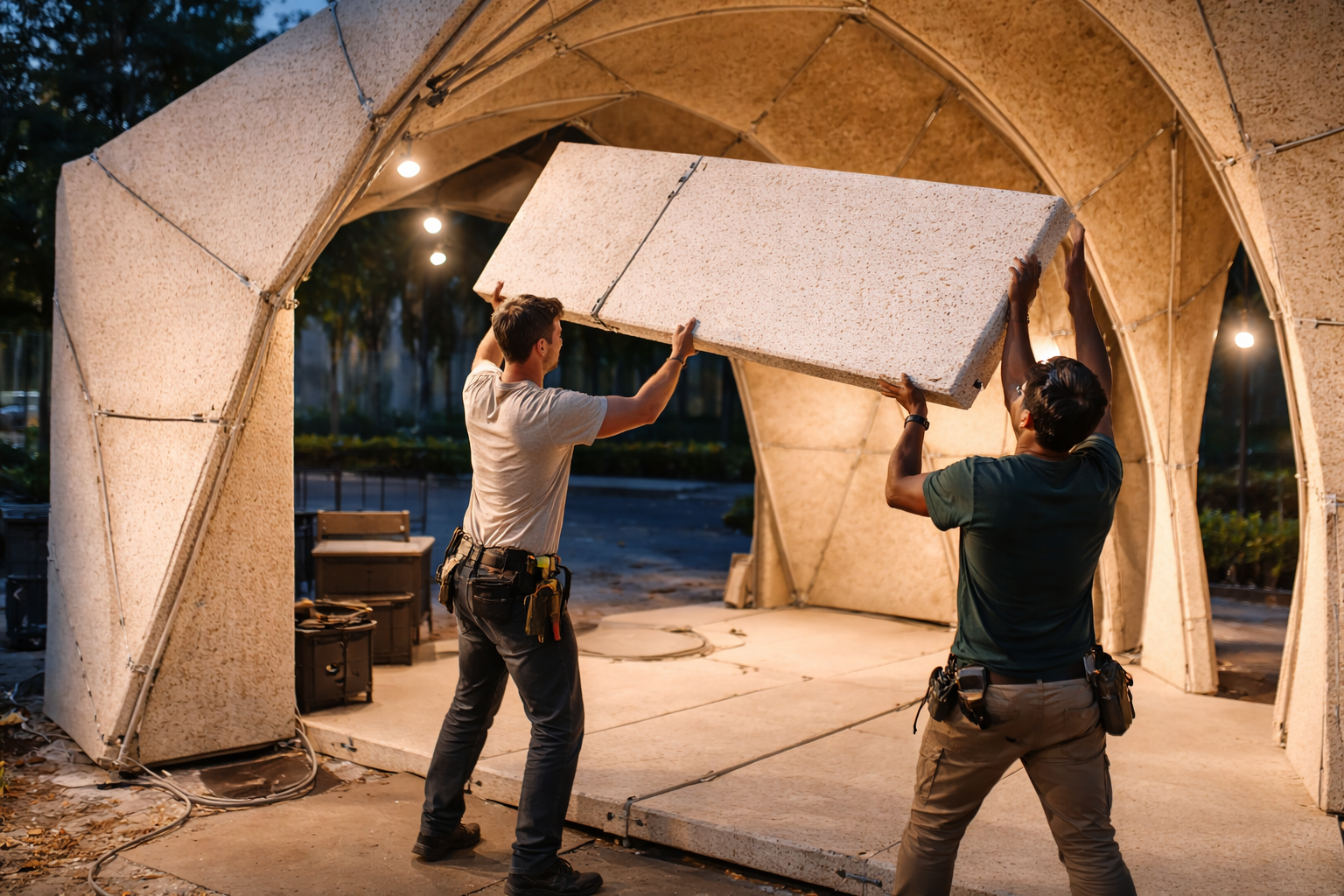
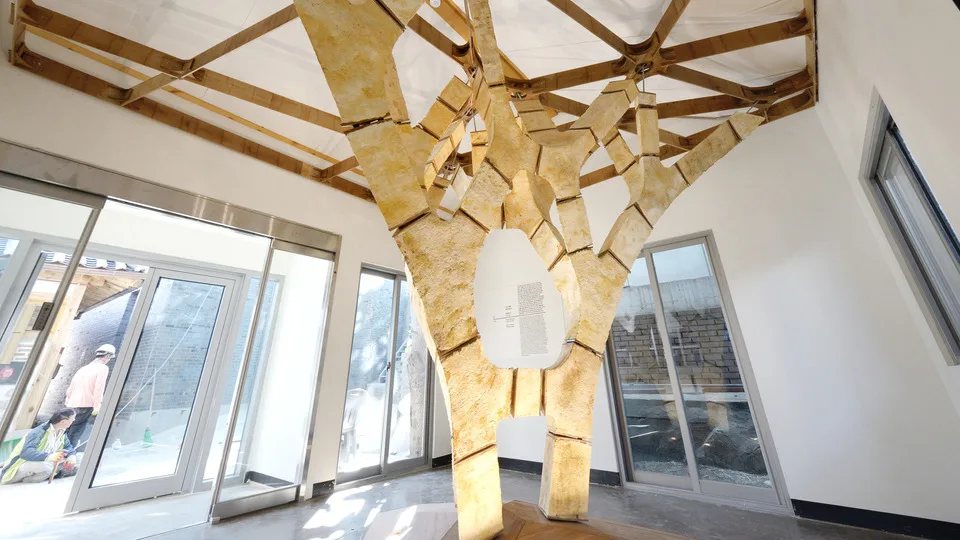
Imagine the time pressure of an exhibition build. It’s 22:00 and the pavilion skin has to be finished. The lightness of mycelium panels is gold here: two people carry them, no heavy crane, fast assembly. And the surface’s “mat organic” language absorbs light nicely; it photographs well. Under these conditions, mycelium composite works: short life, controlled indoor climate, low impact. And at the end, a “dismantle and recycle or compost” scenario can come onto the table—of course where it truly goes and how it is processed is a separate discussion.
Now take the same material outdoors. A municipal procurement team looks at a sample bench piece: “What is the warranty period? How is it cleaned? Does graffiti come off? If a part breaks, is there a spare?” These are the real questions of landscape. Mycelium composite struggles here, because answers often start with “under this condition.” If the climate is harsh (freeze–thaw), rainfall is high, sun is intense, vandalism is common… risk grows. In that situation it becomes a headache; because the project stops defining the material’s limits, and the material starts defining the project’s limits.
A third scene: an interior co-working space; high ceiling, reverberation is annoying. The budget for acoustic panels is limited, but there is also a search for a “material with a story.” Mycelium composite can be reasonable here. The panel is placed high on the wall so it won’t take impact; its surface is protected with a permeable layer that won’t trap dust; a certified product with suitable fire performance is selected. Under these conditions it works; because the problem (echo) and the solution (porosity) align well.
A fourth scene, less discussed: the maintenance crew. Spring cleaning, a habit of washing with a hose. Washing a mycelium composite surface with a hose can mean “insisting on water exposure.” The surface darkens, dries with stains, fibers lift at edges. The maintenance crew quite reasonably says, “I can’t deal with this.” And at that point, material selection becomes not only a design issue, but also an issue of maintenance culture. In landscape, a material lives in the hands of the municipality, not on the designer’s table.
The ethics of the material: sometimes good, sometimes just a story
The ethical side of mycelium composites is worth discussing: using agricultural waste streams, the possibility of local production, reducing dependence on chemical binders—these are genuinely hopeful. But the “carbon” narrative may not always be smooth because steps like sterilization and drying require energy; energy source, logistics, scale, and service life change the calculation. Sometimes the “green” look of the material can even become a stage for greenwashing: visually organic, narratively bright, yet with an unclear supply chain and uncertain lifespan. What is needed here is a gentle but clear line: not everything that looks natural is automatically good; what is good is good together with its conditions.
Source Notes
- Camilleri, E.; Narayan, S.; Lingam, D.; Blundell, R. – 2025 – Mycelium-based composites: An updated comprehensive overview – Biotechnology Advances. L-Università ta’ Malta
- Motamedi, S.; Rousse, D.R.; Promis, G. – 2025 – A Review of Mycelium Bio-Composites as Energy-Efficient Sustainable Building Materials – Energies. MDPI
- Lewandowska, A.; Sydor, M.; Bonenberg, A. – 2025 – A Review of Mycelium-Based Composites in Architectural and Design Applications – Sustainability. MDPI
- Aiduang, W.; Jinanukul, P.; Thamjaree, W.; Kiatsiriroat, T.; Waroonkun, T.; Lumyong, S. – 2024 – A Comprehensive Review on Studying and Developing Guidelines to Standardize the Inspection of Properties and Production Methods for Mycelium-Bound Composites in Bio-Based Building Material Applications – Biomimetics. PMC
- Le Ferrand, H. – 2024 – Critical Review of Mycelium-Bound Product Development: Barriers to Entry and Paths to Overcome Them – Journal of Cleaner Production. ScienceDirect
- Madusanka, C.; Udayanga, D.; Nilmini, R.; Rajapaksha, S.; Hewawasam, C.; Manamgoda, D.; Vasco-Correa, J. – 2024 – A review of recent advances in fungal mycelium based composites – Discover Materials. Springer Link
- Alaneme, K.K.; Okafor, A.U.; Omotoyinbo, J.A.; Bodunrin, M.O. – 2023 – Mycelium based composites: A review of their material properties, biomedical applications and future perspectives – Ain Shams Engineering Journal. ScienceDirect
- Majib, D. et al. – 2024 – Fungal Mycelium-Based Biofoam Composite: A Review on Growth, Properties, and Application – Progress in Rubber, Plastics and Recycling Technology. ScienceDirect
- Verma, N.; Jujjavarapu, S.E.; Mahapatra, C. – 2023 – Green sustainable biocomposites substitute to plastics with innovative fungal mycelium based biomaterial – Journal of Environmental Chemical Engineering.


