

While scrolling through X, I came across a sentence by Ali Kaan: “Turks deserve to live not in cramped apartment flats, but in real Turkish houses with courtyards.” At first glance, the sentence may sound a bit romantic, even a bit assertive… Yet there are some sentences that, before proving their truth, awaken a desire to imagine. That’s what it did for me. Suddenly, I found myself in that stone-paved courtyard from the image, standing beside a flowering tree whose shadow fell softly onto the ground, in front of a house whose wooden windows filtered the morning light gently inside. Then I added a garden behind that vision. A well, a divan, a faint sound of water, vines leaning against a stone wall, a bay window above, a hayat in between, a sofa inside… And then I realized: I wasn’t just thinking about a house; I was imagining a way of life.
Then I decided to prepare a detailed article so that everyone could understand the features of Turkish houses. Of course, I started with research. I encountered drawings, terminology, interpretations of old urban fabrics, and a spatial worldview stretching from Safranbolu to Bukhara. And in the end, I saw this more clearly: the Turkish house is not merely an architectural heritage of the past. It is also a thought written into space about how we might live together, how we should perceive, and perhaps even how we can remain human.
In most modern cities today, buildings rise within their parcels with individual ambitions. Each stands independent, sometimes even in rivalry with the others. In the traditional Turkish city, however, the relationship is different. A house considers not only its own comfort but also its neighbor’s light, the street’s shade, and the neighborhood’s air. That is why, in traditional horizontally developed Turkish neighborhoods, there is said to be a sensitivity that can be summarized as: “one house’s shadow should not block another’s sunlight.”
Today, we often discuss housing in terms of square meters, façade, view, number of rooms, kitchen type, and site amenities. Yet the traditional Turkish house asked this question differently. Rather than “how big should a house be,” it focused on what kind of life a house should carry. This small difference actually transforms the entire architectural approach. Because then the structure ceases to be a shell enclosing a person and becomes an organism that accompanies daily rhythms, shapes the relationship with nature, and invisibly preserves the ethics of neighborliness.
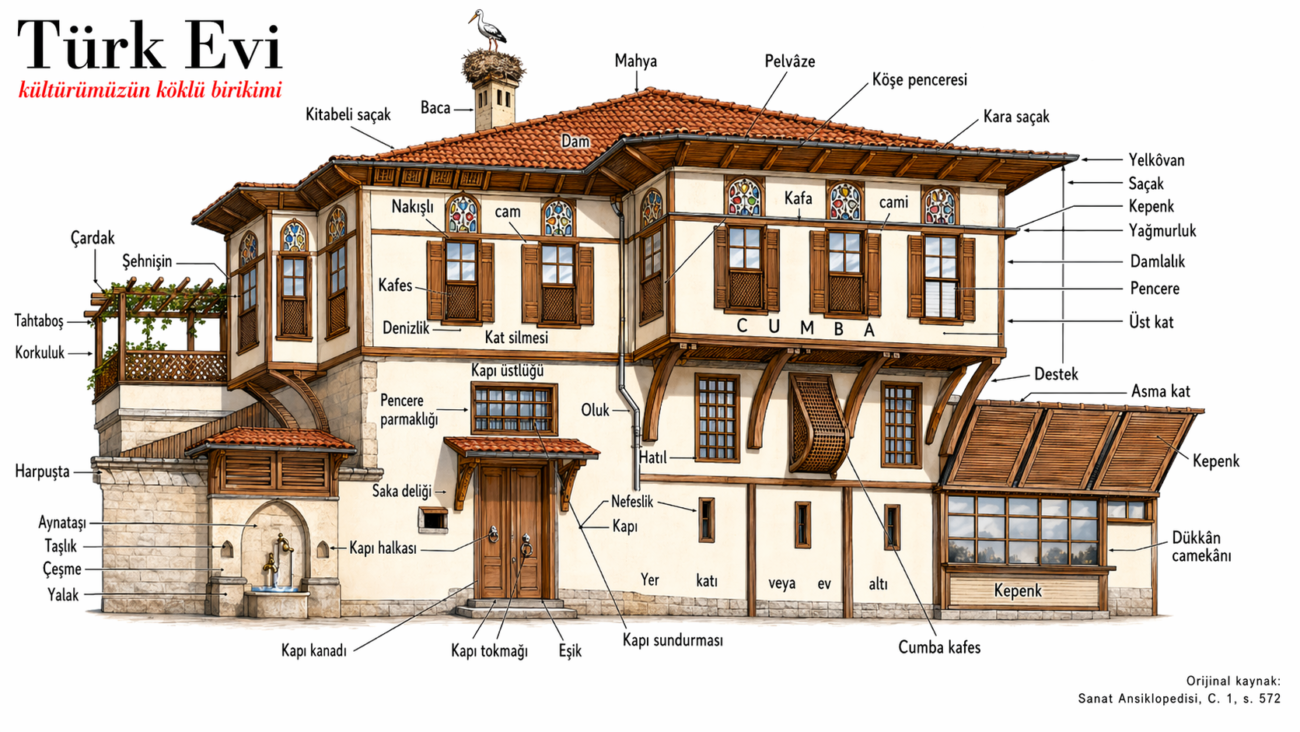
When one thinks of a Turkish house, the bay window usually comes to mind first. White plastered walls, wooden beams, deep shadows under the eaves, stone-paved streets, and sometimes high courtyard walls… Yet trying to understand the Turkish house only through its appearance remains incomplete. Because its strength lies partly in an internal logic not immediately visible from the outside. At the center of that logic is a sense of measure. But this measure is not merely mathematical or geometric. It is also about propriety, rights, climate knowledge, and the subtlety of living.
For this reason, when discussing the Turkish house, one must also discuss the city. Because the Turkish house is rarely independent from the street. It is an organic extension of the urban fabric it belongs to. In most modern cities today, buildings rise within their parcels with individual ambitions. Each stands independent, sometimes even in rivalry. In the traditional Turkish city, however, the relationship is different. A house considers not only its own comfort but also its neighbor’s light, the street’s shade, and the neighborhood’s air. That is why, in traditional horizontally developed Turkish neighborhoods, there exists a sensitivity summarized as: “one house’s shadow should not block another’s sunlight.”
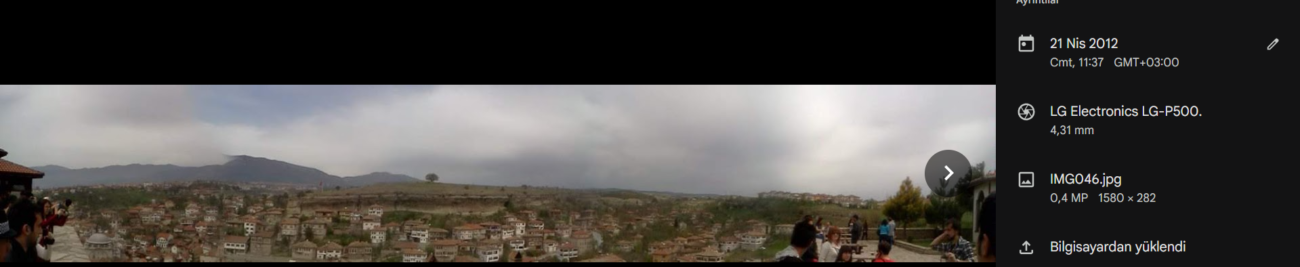
When thinking of Turkish houses, one of the first cities that comes to mind is undoubtedly Safranbolu. Interestingly, while writing this piece, I went back to my own photo archive and revisited the day I first saw Safranbolu. I realized that I first visited this city exactly 14 years ago, on April 21, 2012. Despite the time that has passed, the feeling of that first encounter remains vivid. Even in times when the buildings were not presented as spectacularly as today, Safranbolu evoked deep admiration. Because what was impressive was not just the beauty of individual houses, but the measure, calmness, and elegance of the entire fabric.
Looking at settlements like Safranbolu, this becomes even more concrete. As houses settle on slopes, they do not simply compete to capture the best view. Instead of an aggressive logic that blocks each other completely, there is a composition that steps back, layers, and breathes. That is why these houses do not only look beautiful; they also feel fair.
At this point, it is possible to speak of a silent connection between urbanism and morality. Because the Turkish understanding of the city is not merely a physical arrangement to meet housing needs, but the spatial manifestation of the relationship between people and nature.
Streets are also an important part of this system. Narrow streets are often perceived negatively today. Yet in traditional contexts, narrowness does not necessarily mean congestion. On the contrary, narrow streets create shade, protect pedestrians, and establish a human-scale relationship between buildings and people.
Among the most striking façade elements is undoubtedly the bay window. The bay window is the face of the Turkish house extending into the street. Yet this extension is not aggressive; it is measured. It establishes a relationship with the street, expands the view, and enriches spatial perception, while maintaining a delicate balance between public and private life.
The Turkish house is not merely an architectural heritage of the past. It is also a thought written into space about how we might live together, how we should perceive, and perhaps even how we can remain human.
When we step inside, we encounter another world. The Turkish house does not abruptly throw us into its center; it slows us down. This is why the taşlık (entrance hall) is important. It is a transitional layer between outside and inside—neither fully exterior nor interior.
One of the most important concepts of the Turkish house is the “hayat.” Even its name reveals the intention of this architecture. It is not merely an empty space, but a lived space—a semi-open interface where house, courtyard, and daily life meet.
Connected to the hayat, the sofa forms the backbone of the house. It is not just a circulation space but a shared center where family life converges.
In some regions, the eyvan joins this richness of transitional spaces. It plays a crucial role in climate adaptation, providing shade and airflow, while adding rhythm and ceremony to spatial experience.
The arrangement of rooms continues this philosophy. Rooms are not rigidly fixed to single functions but remain flexible, adapting to different uses throughout the day.
The courtyard and garden are where the Turkish house meets landscape. The courtyard is not a decorative addition but an essential part of life—sometimes even its heart.
Material language reflects the same simplicity. Stone provides solidity and coolness on the lower levels, while wood offers flexibility and warmth above.
Perhaps this is why thinking about the Turkish house is not merely historical curiosity. It also raises serious questions about today’s cities: why do we produce so many buildings, yet so few living environments?
Maybe we cannot recreate the exact houses of the past. But we can reinterpret their principles: transitional spaces, semi-open areas, neighborly rights, climate sensitivity, and the integration of landscape.
For me, this is where the Turkish house becomes valuable. It is not a nostalgic object, but a quiet teacher reminding us that another way of living is possible.
- Perhaps we cannot rebuild the same houses, but we can rebuild the same refinement.
- Perhaps we won’t walk the same streets, but we can help streets remember people again.
- Perhaps not every home will have a courtyard, but every life needs a bit of sky, shade, greenery, and a spatial ethic that considers others.
This is what the Turkish house tells me. And perhaps that is why it belongs not only to the past, but also to the future.


