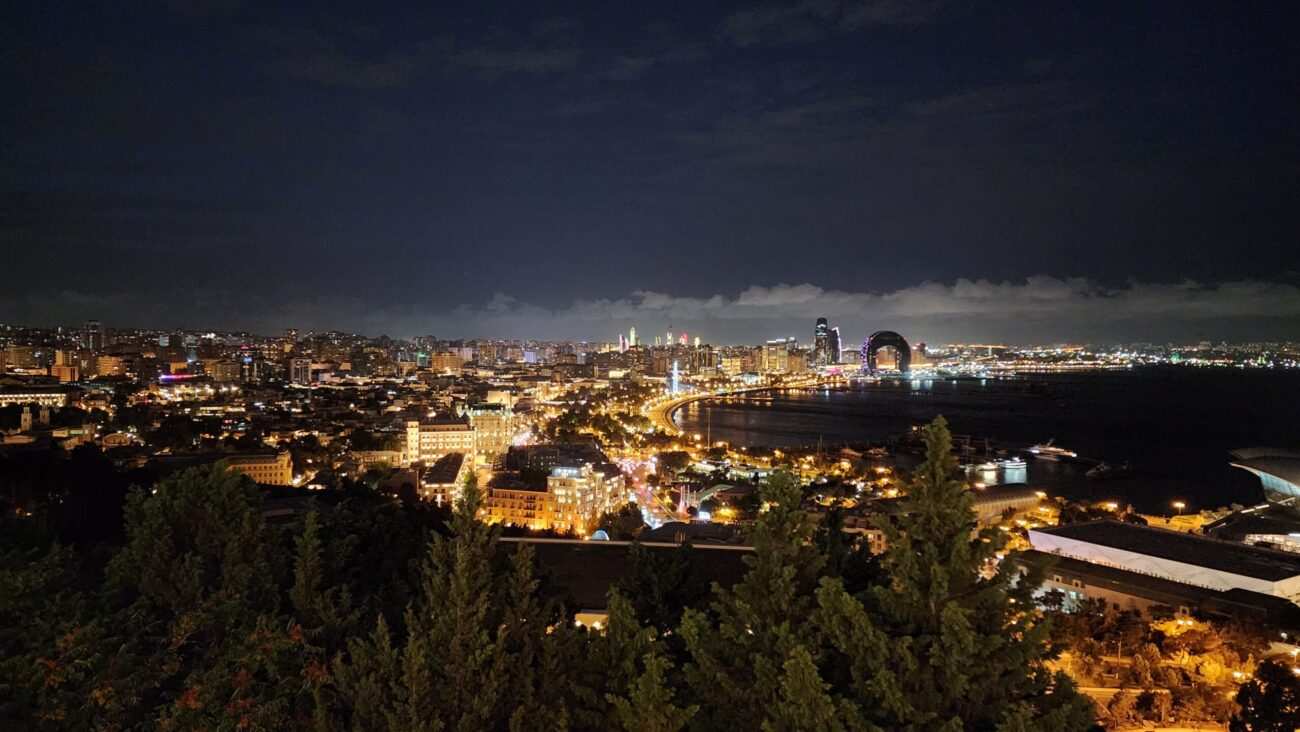

The ticket is punched, the door closes, the cabin gives a slight shudder. The gears begin to clatter like an old music box, slowly turning the city’s secrets toward us. As the Ferris wheel rises, the city finds the courage to look at itself from the outside. What appears from above is not a plan; it is a polyphonic song, too many-voiced to be expressed with a single line. Somewhere the wind, somewhere else a bus horn; on one corner the laughter of the city crowd, on the other side footsteps on the pavement, like a broken clock… Height does not only increase distance, it also enlarges conscience: every point below is someone’s everyday fate.
When you watch the city from above, the language of space can be read more clearly. Lengthening roads are verbs, squares are adverbs, trees are the adjectives in the sentence. Benches are periods, stairs are colons; they say, “From here on, something else will begin.” A child’s voice is an exclamation mark; the silence on an elderly shoulder is an ellipsis… Landscape architecture, in this language, is not spelling rules but the melody of flow. The designer is sometimes the songwriter of the song, sometimes merely a well-tuned instrument performer. A city’s good design is understood not from the heights, but from the levels where sounds can collide without hurting one another.

The Ferris wheel quietly reminds us of the argument between centripetal force and the centrifugal. Is the city pulling us to the center, or flinging us to the edges? Like a river flowing in the same direction as the morning traffic, we are dragged toward the center; in the evening, on the way home, each of us tries to find a small shore. The child who takes refuge in the play area, the old person curling into the shade of the bench, the worker cutting through the narrow path between two vacant lots… Each seeks their own miniature door. Good landscape legitimizes these shores. The shade of plane trees continuing along the street axis, surprise sculptures placed at street corners, a heart and two letters carved into a tree trunk… They all tell the same thing: “You can stay.”
The city’s most genuine clock works with shadows. Clock towers show the hour; shadows show time. The minute hand of noon and the hour hand of morning are not the same. Because the backrest of a bench is tilted five degrees more, it holds the sun on your face ten minutes longer; those ten minutes are the time in which a mother can comfortably decide to breastfeed, an elderly person can straighten their back, a child can finish the game and say goodbye to a friend. Design is the name of a rehearsal of humanity played out in millimeters. Small gestures not seen in the drawing are the great reliefs of everyday life.
From above, even the route of the wind becomes visible. One street has accelerated between tall blocks; another glides gently between two poplar trees. The designer who reads the wind also arranges the sound (see: the Noise Screen Function with Playa Honda City Park). Screen-leaved trees place their fingers on the wheel of the wind; water mirrors do not break the noise, but teach you to speak with it. There is justice in acoustics: peace should be shared not only with villas but also with those waiting at the bus stop. Fairness comes to the city when decibels are distributed justly as well. The engine noise that hits the wall of a schoolyard settles as an unease etched into memory from age three to thirteen. Pocket parks built between buildings to escape the city’s noise (see: Greenacre Park) are not a luxury but a public right.
With every turn of the Ferris wheel, another story leaks in through the glass. The simit seller at the corner rotates the stand according to the wind; as rain approaches, he lowers the edge of the awning by a few centimeters. In the side street, a courier loses not time but patience at a ramp that does not exist on the sidewalk. In the park across, because shadow projections were miscalculated, the slide becomes orphaned in the afternoon. At an apartment entrance, the tactile guiding surface has turned into decoration with a wrong restoration; for someone who cannot see, the guiding line has been sacrificed to the line of ornamental marble. Sometimes the city, with a desire for grandeur, loses its manners; it stumbles in the ethics of details. Right here, landscape architecture can be an invisible vigil of justice.
The city also speaks with its smell. Into the warm smell of bread spilling out from the bakery, the heavy odor of traffic smoke mixes; a street corner becomes identified with the scent of the oleaster tree from your childhood. The right plant blossoms at the right time and works like a navigation device: “If this scent has arrived, home is near.” Smell is the city’s most democratic sign; it shows the way even to someone who does not know how to read a signboard. Constantly sprayed chemical “cleanliness” smells erase the memory of place. It is possible to keep things clean with respect, without turning the city into a sterile hotel; smell is the right to remember.
For a landscape architect, the city is a place where not only forms but also pauses are designed. A bench where stopping is not shamed, a shade where waiting is not considered a crime… To see “waiting” only as a patience test at traffic lights is an injustice to the city. Waiting is a chance to fold inward and breathe. That is why the orientation of benches does not look only at the view; when placed correctly, it also opens a door for a person to look inward. In an arrangement where two benches face each other and, at the midpoint, a tree trunk softens the dialogue, greeting becomes possible without being acquainted. Public life matures as small possibilities multiply.
The Ferris wheel metaphor does not reduce the city to entertainment; but it reminds us of the seriousness of play. Play is the stage where rules and freedom are equalized. The tremble of a child as they toss their first stone onto a hopscotch line is kin to the breath a young person adjusts as they reach for a microphone for the first time to sing in a square. Both are the name of courage waiting at the threshold of the public. The city should be a greenhouse that carefully grows courage. An engine that lowers its decibel, a driver who swallows the delay, a tree that shares its shade, a sidewalk that shares its line… The sum of small kindnesses becomes a great fortune of courage.
Materials have a morality. The rust of a screw reveals neglect; the rudeness of a level difference reveals haste; the smirk of patch asphalt poured as “urgent intervention” reveals sustainable unsustainability. The generosity of design is read in the tenderness of the material. The roughness of a surface that touches a child’s palm, the soft curve of a curb that meets an elderly person’s cane, a red brick used purely for aesthetics instead of using briquettes on a wall… When all of these come together, the sentence “I’m glad I’m here” comes out of the mouth. This sentence is the most reliable satisfaction index for a well-mannered city.
Time is a topography in the city. Between morning and evening we rise and fall. At noon, avenues are held on the axis of the sun; toward evening, streets lengthen, shadows take a nap on the ground. Design is the art of making this topography walkable. A pergola that reads the sundial, a fence that tames the wind, a channel that carries water without spilling while letting you walk over it… What we call “detail” in architecture is, in fact, the disciplining of time.
At the top of the Ferris wheel there is a brief pause. Below, as a child lets out the string of a kite, the wind, with a shy courtesy, tests the line. A cargo worker presses the doorbell with the trained motion of their wrist, steps back and leaves space. A bicycle path curling like a ribbon patiently accompanies the rough flow of an avenue. A cat arranges its life according to the animal lovers of the neighborhood. These small scenes become more convincing than the city’s big claims. Because life takes its inspiration not from giant statues, but from small courtesies.
Beauty in the city often comes not with speed, but with nests placed between speeds. A soft strip of grass laid not right on the running track but on its edge; a narrow balcony set on the mid-landing of a stair; a step-seating unit by the stream that says “wait and listen” instead of rushing past… The city reminds us of being human with these small calls to “stop.” Some count this as inefficiency; yet a person lives not for efficiency, but for meaning.
One day I wish to see a giant inscription in the middle of the city: “Curiosity Allowed.” Because where there is no curiosity, a street is merely a geometric necessity between two points. When curiosity is allowed, the street becomes an ethical possibility between two people. Children climb onto a corner stone and wave to a world taller than themselves; young people tune a guitar at the base of a wall; the elderly know the subtlety of placing shadows side by side. If curiosity is free, the city learns; if the city learns, we change too.
As the cabin slowly descends, we lock eyes with the city’s eyes. Below, nothing looks as if it has changed, but I may have changed. Perhaps the Ferris wheel exists for this: to see the same view, one turn later, as a different person. Design is a bit like this; it transforms not the material, but the one who looks. Today, that narrow shade at the entrance of a park that I passed by without noticing, tomorrow I will seek consciously. If today I do not hear the wheel catching on a threshold, tomorrow I will hear that sound like the city’s highest alarm.
When the door opens to get out, the lines on the ground are again the lines we know; but our words have multiplied. The city is no longer only a job in my plan notebook; it is a sentence fogged onto the cabin’s glass. Like a child drawing a heart with their finger, I write an invisible message into the air with my finger: “Let’s turn again.” Perhaps in another season, with another light, in the sound of another wind… Sometimes one more turn is needed to give the city its due. And each turn whispers the same question: “Today, with which small detail will you make the world a little more livable?” Speaking of a notebook, I would like to bid farewell with my poem that I recorded in my agenda dated April 5, 2013:
We all grew up in the same geography, We are the same children of different bodies.. Axes are the same, traces are the same, sounds are the same, words are the same.. The view is the same, the shutter is the same, the photograph is the same.. Is there no one who can think differently? For years we have been using the same architecture, On the street the lamps are the same, In the kitchen the cupboards.. We decorated our dreams with the same colors, We saw the same people every day, We walked home from the same street.. We got so used to seeing the same things, We became enemies of differences. The same thoughts took place, The same words were spoken. Now, We need to say something new..
