
Hızlı Git
Pruning is not simply “cutting”; while shaping a plant, you are also managing a wound. The wrong pruner crushes the branch; the right one tends to speed up recovery. In a way, your pruner works like a translator between you and the plant: you say “shorten,” and it tries to tell the fibers as gently as possible… or, on the contrary, it delivers a rough sentence and bruises the branch.
I wrote this guide not to answer a single-choice question like “which pruner is best?”, but to get closer to “which one is right for my plant and my hand?” Because a rose shoot and an old apple branch don’t speak the same language; and the repetitive trimming of a hedge doesn’t progress peacefully with the same tool as a one-time shaping prune.
Types of pruning shears
Bypass pruners (cut like scissors)
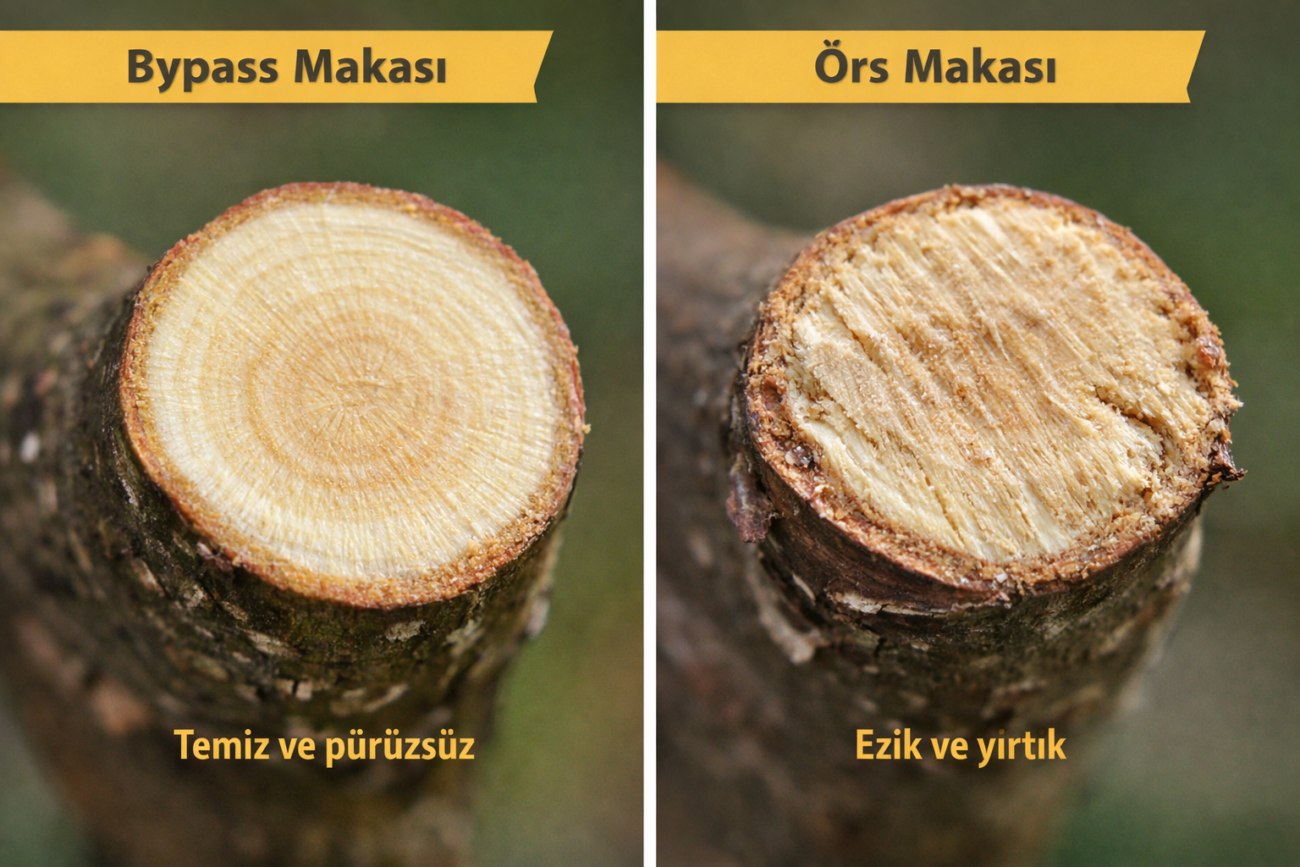
Bypass pruners work with the classic “scissor” logic, where two blades slide past each other. Because the branch fibers are crushed less during the cut, they tend to leave a cleaner wound surface, especially on live and relatively fresh shoots. In practice, this usually means: when pruning roses or shortening young fruiting shoots, you see a smoother line on the cross-section instead of a torn edge. From a plant physiology perspective, a cleaner cut can make callus tissue formation (the tissue that closes the wound) easier; at least in many cases, the healing process looks more orderly and controlled.
Bypass pruners have a small “habit”: when forced on very hard, dry, old wood, the blades can slip or fail to grip the branch properly. At that point, the required hand force increases, the wrist gets tired; and sometimes, while thinking “just a bit more pressure,” you unintentionally invite crushing back into the picture. So bypass is not always a romantic solution; it is excellent in the right place.
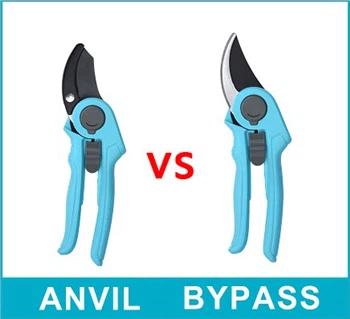
Anvil pruners (press the blade onto an anvil)
In an anvil design, a sharp blade cuts by pressing the branch against a flat surface (the “anvil”). This often gives a “stronger cutting” feeling on dry and hard branches, because the wood is supported against a surface, letting the blade advance more easily. But that convenience can bring crushing on some materials: fibers may compress and tear, and on juicy, live shoots the cut face can look more bruised or mashed.
Anvil pruners can be very useful in some gardens, especially for deadwood clean-up, lower shrub work, and quick “tap-tap” clearing. But for delicate pruning (roses, young shoots, grafting wood and similar), bypass is often the safer choice.
In short, bypass is strong on the “clean wound” side; anvil is practical on the “let me cut hard wood” side. Yet both can find a place in a garden; the key is not to mix them up and to know where you are using which tool.
How to read cutting diameter
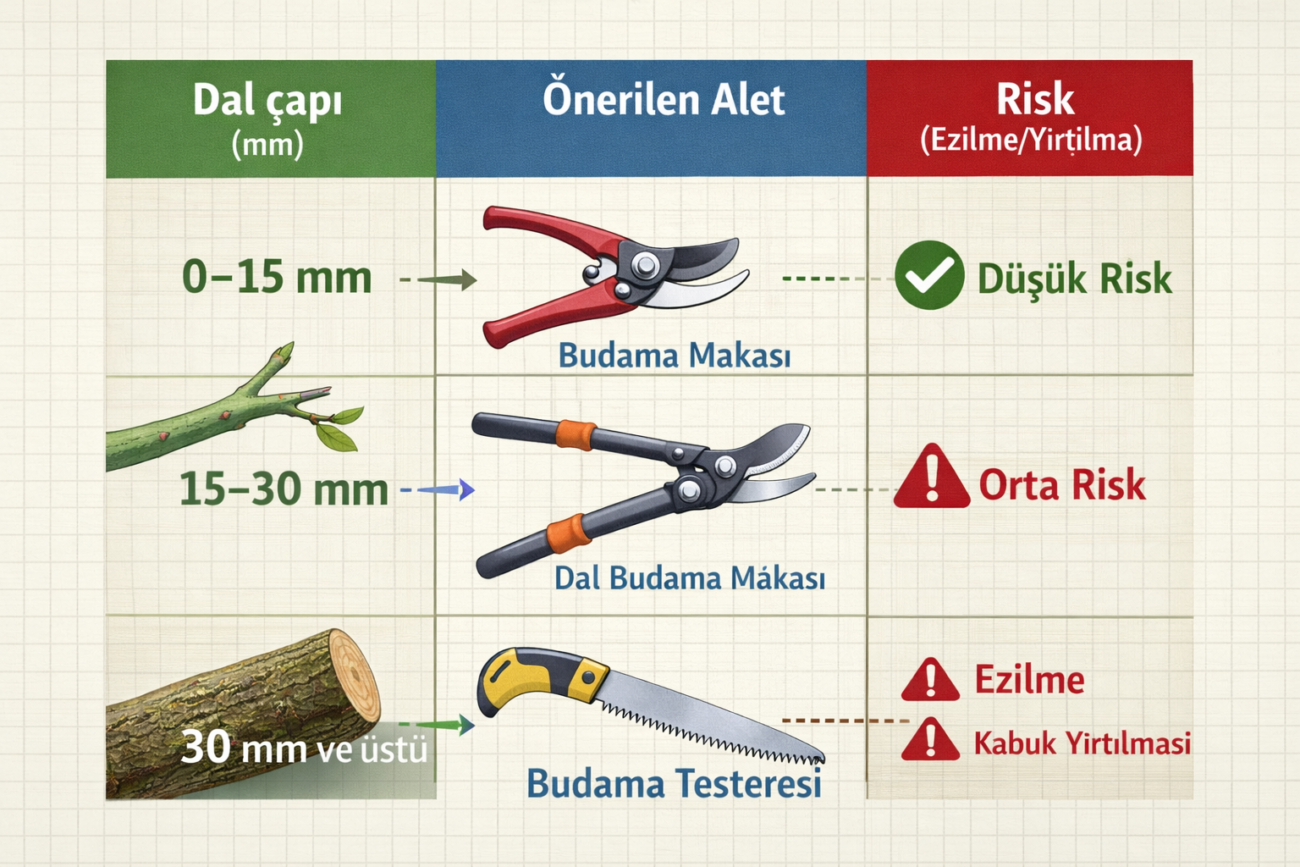
When buying pruners, you’ll see a “maximum cutting diameter” on the box (for example 20 mm, 25 mm). That number is often an upper limit given under ideal conditions: correct angle, wood that is not overly old, and a clean cut technique. So if it says 25 mm, assuming “it will crunch through any 25 mm branch” can sometimes end in disappointment. The branch’s hardness, species, fiber structure, and the force you can apply all change the outcome.
A practical approach helps here: don’t treat cutting diameter as a standalone spec; think together with “cutting comfort.” A pruner rated 20 mm but with excellent geometry may tire you less; a model labeled 25 mm with weak blade geometry can become a struggle even at 18–19 mm. That’s why, before purchase, holding it in your hand and checking the open-close feel, blade alignment, and the reliability of the lock is a small but effective test.
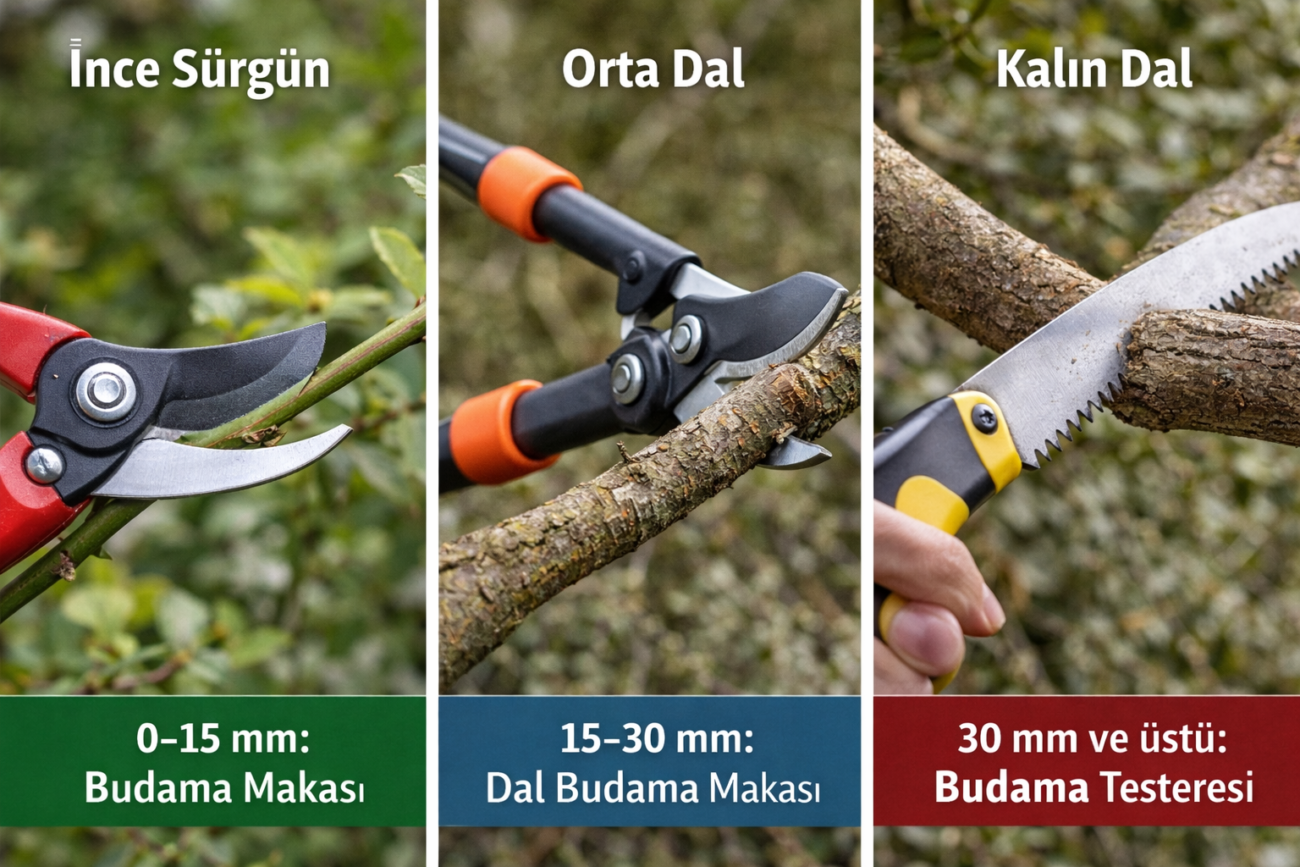
And one more thing: as diameter increases, the right tool often shifts to a long-handled lopper. Instead of forcing hand pruners beyond their comfort zone, handing the job to a lopper or a pruning saw tends to give a cleaner cut and safer work.
Handle ergonomics and hand health
Pruning is largely a repetitive motion. You start with “I’ll just cut a couple of branches,” and then, without noticing, an hour passes. Ergonomics enters exactly here. How the handle sits in your palm, whether opening and closing forces your wrist into an unnatural angle, how stiff or soft the spring feels… These seem simple, but by the end they can reach the point where your hand starts to shake.
A few small observations often help when judging ergonomics:
- If the handle is too thin, especially for larger hands, gripping force increases and fatigue arrives quickly.
- If the handle is too thick, control decreases in smaller hands; you begin to hold the tool by “clamping” it.
- A soft, rubber-like coating reduces slipping, but on sweaty hands it can sometimes feel a bit sticky; material quality matters here.
- If the lock can be opened and closed with one hand, your workflow doesn’t break. And when the workflow doesn’t break, accidents caused by “rushing” tend to decrease.
For people with sensitivities such as tendinitis, wrist pain, or carpal tunnel symptoms, pruners with a ratchet (step-assisted) mechanism may be helpful. Not a miracle, but because the force is delivered in stages, it can feel relieving for some users.
Blade steel and coating differences
The heart of a pruner is the blade, but the blade has its own character too. In general, steel with better heat treatment keeps its edge longer; however, not every “hard steel” is ideal for garden work. A very hard but brittle blade can develop micro-cracks with misuse (hitting stone, wire, very hard deadwood). Tougher steels can lose sharpness a bit faster, yet they are more forgiving in the field. This balance depends on the manufacturer and overall quality; so judging only from “steel type” is not fully reliable, but it still gives a rough orientation.
As for coatings, non-stick (Teflon-like) coatings reduce sticking on resinous branches. When pruning roses or certain shrubs, that sticking can be genuinely annoying; a coating improves comfort. But coatings scratch when maintenance is neglected; once scratched, you may start feeling a repeated “snag” at the same point. So a coating is not quality by itself; it gains meaning together with a consistent maintenance habit.
Availability of replacement blades is another small but critical topic. A pruner with a good body can be used for years if you can renew the blade. Some brands make this easy; others follow a “if it’s worn, buy a new one” logic. If we are going to talk about sustainability in gardening, spare parts are not a minor detail at all.
When does a pruning saw take over?
There are branches that look “cuttable” with pruners, but in truth they push the tool beyond its proper limits. That’s where a pruning saw comes in. Especially in old fruit trees, thicker limbs and woody shrub stems carry a real risk of crushing if you force them with hand pruners. A saw, with the right tooth geometry, gives a more controlled cut and separates fibers more cleanly without compressing the wood.
Correct saw technique matters too: to prevent the limb from tearing downward under its own weight, making a small safety undercut first is a classic, almost life-saving technique. Otherwise, the branch can snap and rip the bark downward; the main wound enlarges and healing becomes harder. These technical details connect tool choice directly to the “plant health” dimension.
Sharpening and maintenance
Cleaning
A pruner’s performance is often measured not by “day-one sharpness,” but by “is it still doing the job by the end of month four?” Resin, sap, and soil leave a film on the blade. This film makes cutting harder and increases rust risk. Wiping it with a simple cloth after pruning already makes a difference; on resinous branches, if needed, light cleaning can be done with a mild agent (in a way that doesn’t harm the tool’s material).
Another point: if you cut branches suspected to be diseased, blade disinfection becomes important. It’s best to proceed without overdoing it but without neglecting it either. Maybe not for every single cut, but in situations with a real transmission risk, cleaning and disinfection support the overall health of the garden.
Lubrication
A rust-preventive oil is especially useful for end-of-season storage. A small drop at the pivot point softens the open-close feel and reduces corrosion. But too much oil attracts dust; so “little but regular” is usually the better approach.
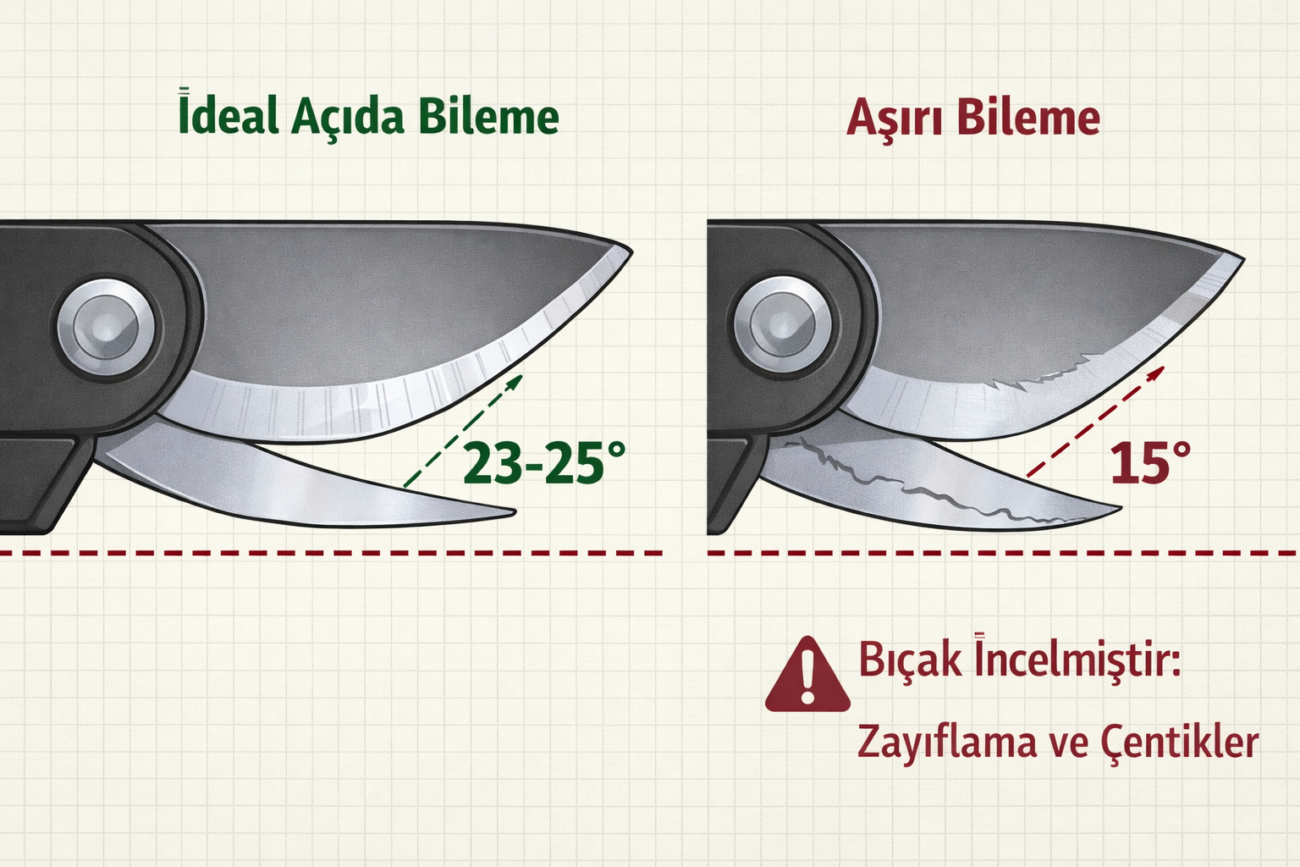
Sharpening with a whetstone is a delicate task: if you keep the angle close to the factory bevel, performance improves; random angles and over-sharpening can thin the blade and weaken it. So if you struggle, using a professional sharpening service or following the manufacturer’s recommended method is often healthier.
Safe pruning: gloves, goggles, ladder
Most pruning accidents come from that small rush of “just one more branch.” Gloves are essential, especially with roses and thorny shrubs; but you also want to make sure the gloves are not so bulky that they ruin your grip. Goggles are a simple, effective protection against unexpected snap-backs, especially when cutting dry wood.
The ladder topic almost deserves its own chapter: pruning alone, on a slippery surface, near the top rungs is a risky combination. If possible, stabilize the ladder, have someone support you, choose proper footwear and a firm base. And if pruning is near power lines, this moves beyond the “hobby” zone into a serious risk field; professional support is the better decision.
3 scenarios: a small set idea for roses, hedges, and fruit trees
In this section I won’t claim “I recommend one single pruner” because that’s rarely realistic. What tends to work better is a small set logic for three common pruning scenarios. Honestly, this is also what makes the most sense in garden retailers: the user understands what they are buying and why.
1) Rose pruning (delicate cut and clean wound)
With roses, the aim is usually a clean cut, the right angle, and removing shoots without crushing. A good bypass pruner stands out here. Adding a small sharpening stone and a basic maintenance product for resin cleaning is a sensible combination. In some cases, a wound sealant (especially on thicker cut surfaces or in sensitive shrub or tree species) can be kept as an option; it is not mandatory for every cut, but in certain gardens it reassures the user, particularly when there is a risk of bark tearing.
2) Hedge work (repetition, speed, comfort)
Hedge pruning is mostly about rhythm: repeating the same motion again and again. That’s where hand health becomes central. If the hedge is wide, hedge shears are another subject, but for occasional woody stems inside the hedge, a long-handled lopper is very practical. Gloves are not only protection here; they also help with grip. A rust-preventive oil extends the life of frequently used tools. In this scenario, comfort details (easy lock, non-slip handle) sometimes make more difference than sharpness—strangely, but true.
3) Fruit trees (thicker wood, controlled cut, not enlarging the wound)
In fruit trees, as wood ages, the need for a saw increases. For thin shoots, bypass pruners can be enough; but on thicker limbs, a pruning saw takes over. A long-handled lopper can reduce ladder use on medium-thickness branches, improving both safety and comfort. Some producers recommend wound sealant particularly for large cut surfaces; climate, disease pressure, and species sensitivity become decisive here. And one more thing: in large limb removal, cutting in a controlled manner rather than “snapping it off” protects the bark. This is as much technique and habit as it is tool choice.