

Hızlı Git
The Ideal Republican Village Project appears to be one of the rare planning documents of the early Republic era that tried to express the idea of “development starting from the village” not only through slogans, but through space itself. Atatürk’s phrase “the peasant is the master of the nation” is not a dry maxim here; it becomes the core of a whole that stretches from schooling to health, from production to green infrastructure. In today’s terms, the plan invites us to see the countryside not merely as an agricultural production zone, but as a living system designed together with education, culture, and social life.
In this article, I examine the Ideal Republican Village Project by reading its circular spatial logic, grouping its 43 different institutions and units into thematic clusters, and, most importantly, by taking seriously the question of “what it tells us today.” Throughout the text, admiration is not hidden; yet the claims are weighed with as calm a mind as possible. Because the strength of this plan is not in exaggeration, but in detail, organization, and, in a sense, in intelligence.
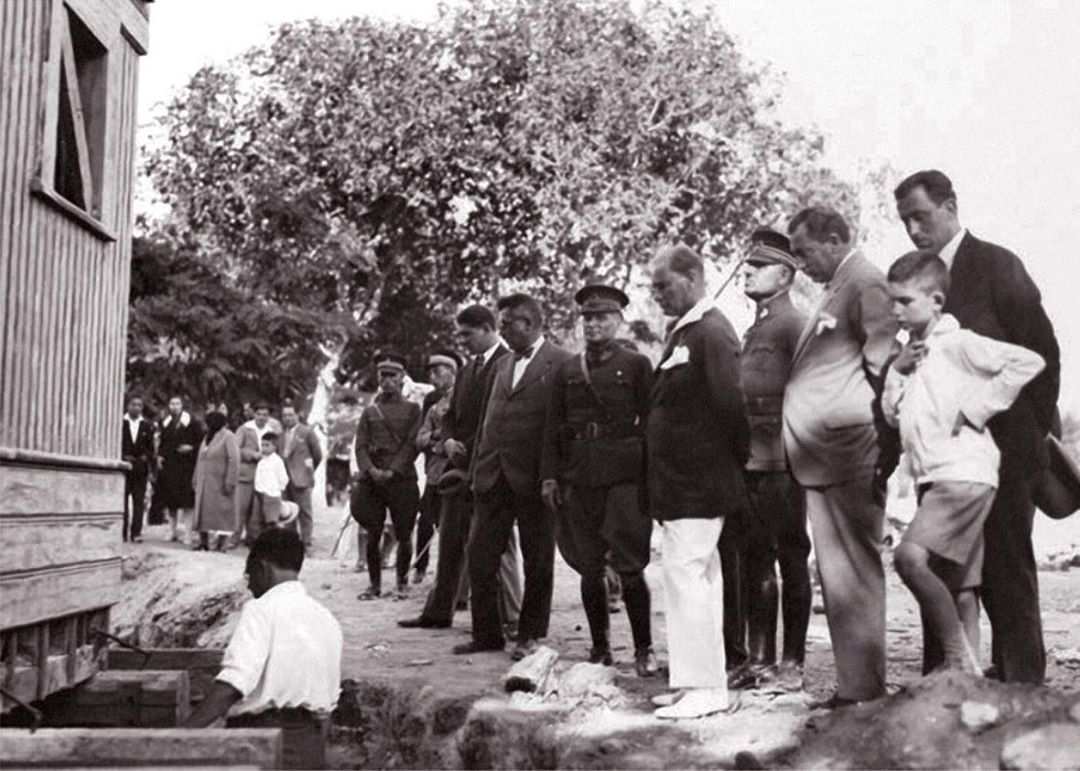
Atatürk’s Love of Nature was something he cared about deeply.
Atatürk’s Bold Vision: What is the Ideal Republican Village Project?
It is known that the Ideal Republican Village Project reached us largely through the accounts of Afet İnan. She states that the plan was given to her by Thrace’s Inspector-General, General Kazım Dirik, and that the plan caught Atatürk’s attention; he wanted it to be improved and implemented. There is a distinction that is often confused here: who exactly drew the plan may be debated; however, the project’s ambition to “transform the countryside” and Atatürk’s view of the village as the center of development form the main backbone of the narrative.
In the 1970s, the plan came to the agenda again. The letters Afet İnan sent to ministries and provincial governors meant that the plan was being “remembered again” amid the rural development searches of that period. Its failure to be implemented can be read not only as the loss of a single project, but perhaps as losing the habit of long-term thinking that the project represented. Because the Ideal Republican Village Project is not a list of buildings; it is a woven organization of life.
The spatial logic: a circular backbone, a center, and rings
The most striking feature of the plan is its circular settlement scheme. There is a small core at the center, surrounded by expanding rings. At first glance it is compared to a dartboard, yet when you read it more carefully, you sense an architecture of graded publicness. The center is designed as the zone where denser public uses gather; moving outward, the relationship with housing, production, agriculture, and natural areas broadens.
The roads extending from the center to the periphery describe not only movement but also hierarchy. In other words, the scheme answers the question “where is the village square?” not with a single dot, but with a layered system. Concepts we discuss today in planning literature—nodes, accessibility, public cores, green belts—seem to have seeped intuitively into the plan. For this reason, rather than simply looking at a drawing, it feels more accurate to read an intention.
| Layer | Approximate function | Examples of units and areas | Translation to today |
|---|---|---|---|
| Central core | Public focus, representation, and gathering | Monument, village square, village park, children’s garden | Social infrastructure and a safe civic core |
| 1st ring | Education, administration, daily services | School, village hall, people’s room, cooperative, shops | Essential services within walking distance |
| 2nd ring | Housing and everyday living fabric | Residential areas, linked to reading and meeting spaces | A calm and orderly neighborhood-scale fabric |
| 3rd ring | Production, workshops, agriculture and livestock | Factory, dairy, mills, breeding stations | Local economy and resilience, cooperative practice |
| Village edge and belt | Natural areas, fields, grove, necessary peripheral functions | Grove, fields, cemeteries, manure area, fairground | Green infrastructure, buffer zones, environmental health |
What do 43 units mean: not a village, but a small blueprint of civilization
Many people are surprised to see a total of 43 institutions and areas mentioned in the plan. This is because in Turkey, the “village” has long been imagined mainly through houses and fields. The Ideal Republican Village Project, however, treats the village as a cultural field, an educational ground, a production order, and an environmental governance issue. What matters here is not the individual buildings, but the system they form by completing one another.
It is possible to read these units as a long list, yet it is clearer to divide them into thematic clusters. The following headings make the plan’s world of ideas more visible: education and culture, health and care, production and cooperatives, infrastructure and safety, green space and recreation, agriculture and livestock. Seen this way, the plan’s search for a rural life model centered on “people and nature” becomes easier to understand.
An education and culture backbone
Units such as the school and practice garden, teachers’ house, reading room, and conference hall show the project’s most ambitious face. There is an approach that does not reduce rural development to “let’s build roads and bring water,” but also aims for intellectual transformation. The practice garden detail is particularly meaningful: it seems designed so that education does not remain theory, but touches the soil and connects to production. This even echoes today’s debates on applied learning.
Health, care, and the order of everyday life
Units such as the midwife and health officer, infirmary, and animal health officer read the concept of health not only through humans, but through a wider web of life. In the village, health is handled together with infectious disease, hygiene, food safety, animal health, and environmental conditions. This perspective can be seen as a rural counterpart to what is described today as “One Health.” In addition, spaces like the bath and washing area recall the social rhythm of cleanliness.
The language of production and cooperatives
Cooperatives, village shops, the marketplace and grain depot, the seed-cleaning building, dairy, mills, and the factory form the economic leg of the plan. What stands out is that production is not limited to fields. Alongside agriculture, processing, storage, distribution, and a kind of local industry are envisioned. It feels like an attempt to break the chain of “income comes from the village, but value is created in the city.” The added-value logic sought in rural development today appears here as an early intuition.
A generous green infrastructure and open-space system
Elements such as the village park, children’s garden, grove, pool, and fountains are the plan’s breathing side. Mentioning the children’s garden together with the center means that childhood is not pushed to the edge of public life, but placed at its heart. The grove, meanwhile, is not only an aesthetic green feature; it may also carry functions such as microclimate regulation, wind-breaking, fuel supply, and shading. In short, the Ideal Republican Village Project treats nature not as decoration, but as part of the system.
Infrastructure, safety, and continuity
Details such as the telephone exchange, village fire brigade, fire service, and toilets reveal the plan’s “everyday realism.” This list shows that the countryside is not romanticized. A village is the sum of infrastructure decisions, and those decisions provide safety and continuity. Moreover, aspects like the location of cemeteries and the manure area suggest that settlement hygiene and environmental health were also considered within the plan. Such details bring the project closer to an “implementable framework” rather than a mere dream.
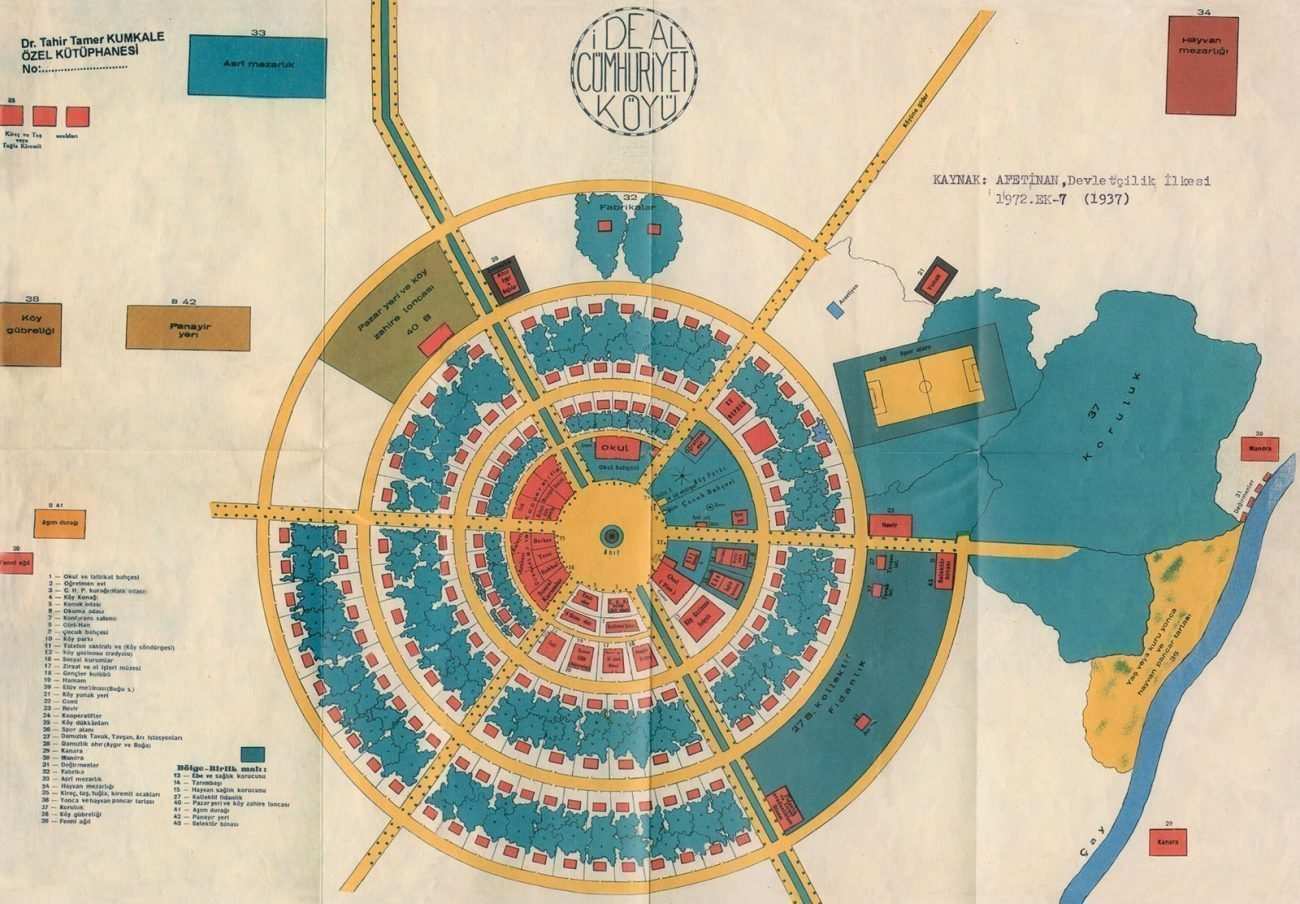
Institutions, buildings, and areas: a more readable classification
The list below preserves the 43 units mentioned in the plan, but I reorganized them into internal groups to make the reading easier. This makes it more visible what kind of life the Ideal Republican Village Project aimed to build. As you read, you notice that a village is not formed only by houses, but by relationships between institutions, public spaces, and production cycles. This also suggests that Atatürk imagined modernization not only in form, but in organization.
- Education and culture: school and practice garden, teachers’ house, people’s room, reading room, conference hall, agriculture and meatworks museum, youth club, radio-equipped village casino
- Administration and social life: village hall, guest room, social institutions, cooperatives, village shops, inn-hotel
- Health and care: midwife and health officer, infirmary, animal health officer, bath, village washing area
- Infrastructure and safety: telephone exchange, village fire brigade, fire service, toilets, fountains, pool
- Open space and sport: children’s garden, village park, sports area, playground, fairground
- Production and agriculture: head of agriculture, mills, dairy, seed-cleaning building, factory, marketplace and grain depot, insemination station
- Livestock and support units: breeding stations for poultry, rabbits, and bees; breeding barn; canary/pen area, scientific fold, manure area, clover and fodder beet fields
- Natural areas and environment: grove, modern cemetery, animal cemetery, lime/stone/brick/tile quarries
Landscape readings: why the plan’s “environmental” side feels strong
What makes the Ideal Republican Village Project especially interesting from a landscape perspective is that it treats nature not as ornament, but as infrastructure. The idea of a grove, the relationship between fields and settlement, the proximity of water features to the civic core, and the placement of functions such as cemeteries in buffer areas all point to an “ecological logic.” Here, ecology is not just a plant list; it means thinking together about siting, hygiene, wind, water, production, and movement.
The children’s garden detail is also precious. Because the place reserved for children sits at the center of the plan—the heart of public life. This shifts childhood from a quiet backyard activity into social visibility. Moreover, placing elements such as the telephone, fire service, fountains, and toilets around the park and children’s garden suggests that safety, maintenance, and continuity were designed together with play. These small links reveal the plan’s intelligence.
In today’s terms: why this plan still feels current
Many themes we discuss today under concepts such as “resilient cities,” “climate adaptation,” “social infrastructure,” and “local economy” find counterparts here at the rural scale. The Ideal Republican Village Project thinks not only about producing housing, but about educating people, diversifying production, and strengthening public space at the same time. This can also be read as a quality-of-life goal that could reduce migration pressure from villages to cities. In other words, the point is not only “beautifying the village,” but making staying in the village reasonable.
And there is another thing: the plan does not proceed with the logic of “let’s build one facility and the problem is solved.” On the contrary, it builds a whole with small pieces that feed one another. School, cooperative, market, dairy, mills, health units, open spaces… They gain meaning not alone, but together. Atatürk’s admirable side becomes visible right there: not a fragmentary mind, but a system-building intelligence. That kind of intelligence is not always present even in today’s project world.
The claim of similarity to The Venus Project: intriguing, but a topic that needs caution
The circular scheme of the Ideal Republican Village Project is sometimes linked to modern utopian plans such as The Venus Project. Here, two things should be separated. First, the circular-plan idea has appeared in many settlement proposals throughout history, from the Garden City tradition to various utopian archives. Second, it is difficult to prove a direct “copy” claim. For this reason, it is more solid to interpret the similarity as the re-emergence of a similar spatial imagination in different periods.
Still, one fact remains: when you pick up this plan today, it feels surprisingly contemporary. Thinking about technology, environment, production, and social life within the same frame is not an ordinary reflex for Turkey in the 1930s. Admiration begins exactly there. Because this admiration is not directed only at a person, but at a country’s capacity for long-term thinking. The Ideal Republican Village Project is a concrete trace of that capacity.

Why it was not implemented: a few possible explanations
The fact that the Ideal Republican Village Project was not implemented cannot be reduced to a single reason. Issues such as financing, administrative continuity, shifting priorities of the era, and the immaturity of institutional mechanisms needed to carry rural development should be considered together. Moreover, such holistic projects go beyond being “the job of one ministry”; they require multi-actor coordination from education to health, from public works to agriculture. Without coordination, even the best plan remains on paper.
There is a hard lesson here: big ideas move not only with big minds, but also with great patience. Atatürk’s vision may have set a starting line; but sustaining that line requires a comparable state capacity and stability. When we discuss this plan again today, perhaps its most valuable side is this: it reminds us how vital what we call “implementation capacity” truly is. And admiration deepens with that reminder.
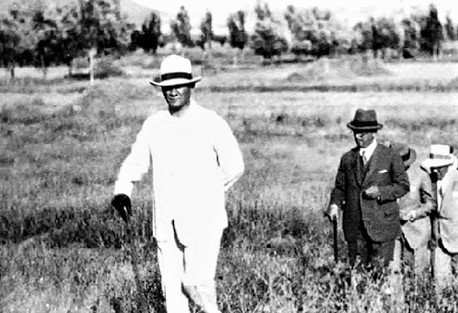
Atatürk Forest Farm was a place he cared for deeply.
Frequently asked questions
Did Atatürk draw the Ideal Republican Village Project?
Claims that directly attribute the drawing of the plan to Atatürk are very common. However, as Afet İnan conveys, the plan does not include the architect’s name; the stronger narrative is that Atatürk took an interest in the project and wanted it to be developed. For this reason, instead of saying “Atatürk drew it,” it is more cautious and more accurate to say “a plan that Atatürk emphasized, supported, and placed within his rural development vision.”
Is this plan connected to the Village Institutes?
It may be difficult to establish a direct implementation link, but they carry the spirit of the same era. Thinking about education, production, and social transformation together creates a strong kinship between the two. Elements such as the school and practice garden can be read as the spatial counterpart of the idea of “applied education” in the countryside. So the connection may be established not through institutions, but through the climate of ideas.
Could the Ideal Republican Village Project be implemented today?
Copying and implementing it exactly today would be difficult, because population, economy, and technology have changed. Yet the plan’s logic still feels applicable: walkable access to services, strong social infrastructure, a local production chain, a green belt, and a child-centered civic core. These principles can be reinterpreted with current regulations and current needs. In that sense, the project can be evaluated not as a rigid “template,” but as a package of design principles.
References and further reading
The links below were selected for readers who want to follow the topic on a more solid footing. This is a compilation and interpretation; it tries to avoid leaning on a single source.
- Afet İnan, The Principle of Statism and the First Industrial Plan of the Republic of Turkey (1933) (TTK Publications)
- DergiPark: https://dergipark.org.tr/tr/download/article-file/401869
- DergiPark: https://dergipark.org.tr/en/download/article-file/357409
- Teyit analysis: https://teyit.org/analiz/ideal-cumhuriyet-koyu-projesini-ataturk-cizdi-iddiasi


