

Hızlı Git
Have you ever noticed how playgrounds in cities are usually lively only in spring or on mild summer days, yet turn into abandoned spaces in winter or during extremely hot summer periods? With the climate crisis and accelerating urbanization, “play” one of our children’s most basic rights keeps getting blocked by weather conditions. So can children’s playgrounds truly be made usable in all four seasons?
In this article, by discussing season-responsive playground design and the idea of child-friendly cities, we will explore how parks can become living spaces 365 days a year.
Seasonality: Not Just a “Maintenance” Issue
The conventional perspective either treats the fact that playgrounds are not used in winter as something natural, or reduces it to a simple maintenance and cleaning issue. Yet studies suggest that climate data (wind, sun, precipitation) should be placed at the center of design when playgrounds are planned.
Based on observations, while park use can be 3–4 times a week in summer, this rate may drop to as little as once a week in winter. However, from the standpoint of urban resilience and children’s rights, the right to play cannot be suspended because of the weather; parks should remain accessible and safe throughout the year.
1. Safe play in scorching summer heat: UV protection and thermal comfort
Although summer means vacation and play for children, extreme heat carries serious risks. The lack of heat-resilient surfaces and adequate shading can make parks dangerous.
- Suggested Solutions:
UV-protected play area: Modular shade structures or canopy systems should be added above play equipment, especially slides and swings.
Natural shading: Deciduous trees should be used so that the area is shaded in summer while allowing sunlight to pass through in winter.
Light-colored materials: To reduce surface temperatures, light-colored ground materials that reflect sunlight should be preferred.
Thermal comfort for children: Children regulate body temperature more slowly than adults; therefore, clean drinking water fountains that allow frequent hydration should be integrated into the site.
2. Why do parks stay empty in winter?
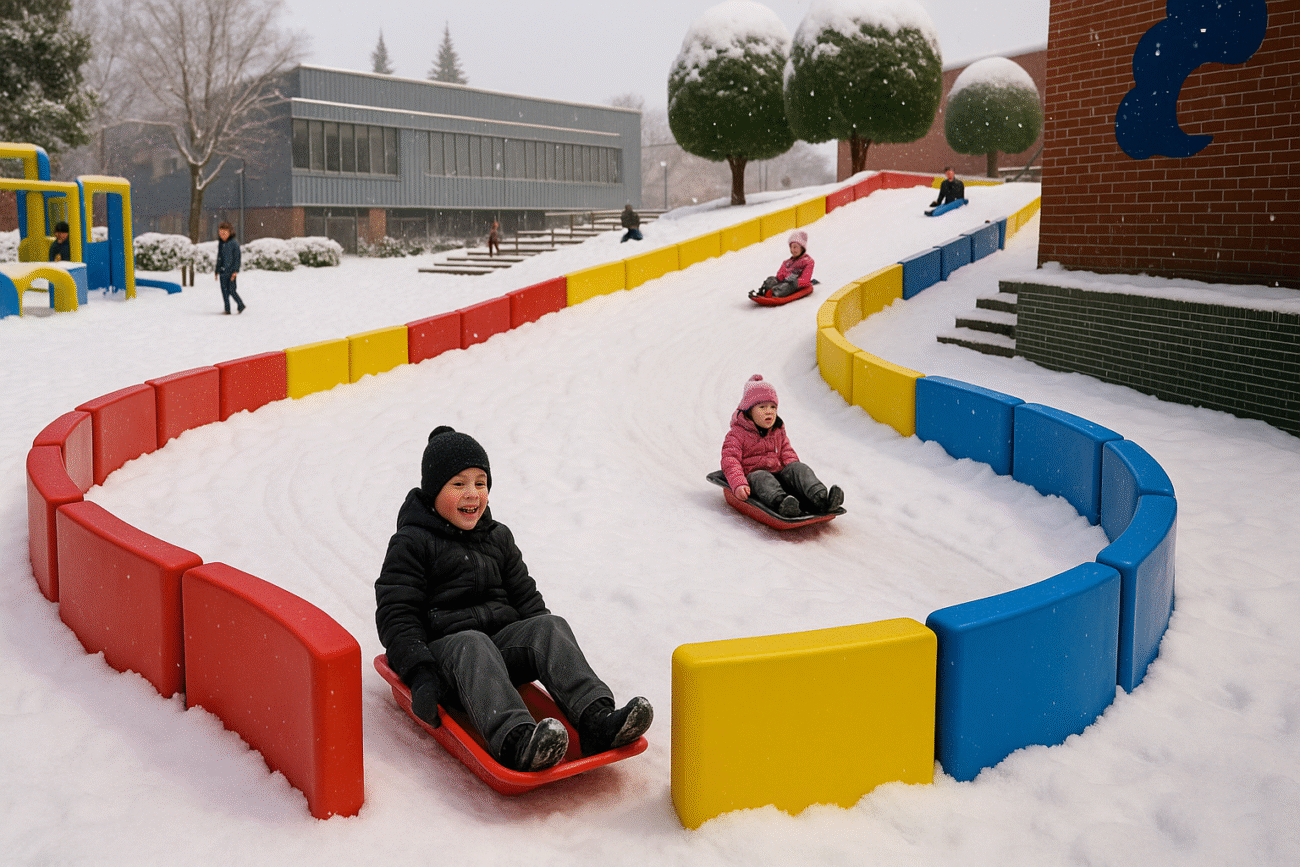
In winter, parents often hesitate to take their children outside due to fear of illness. However, observations from cities with harsh continental climates such as Erzurum suggest that the issue is not only the cold, but also unsuitable design decisions.
- Windbreak Planting: By using dense plant barriers or panels that block northerly winds, the “perceived temperature” can be increased and the wind’s chilling effect can be reduced.
Warm colors: Warm, vivid colors that contrast with winter’s gray-and-white atmosphere can create a psychological sense of warmth and invite children to play.
Lighting: With the shortening of days in winter, lighting levels should be increased to reduce growing safety concerns.
3. Spring and autumn: Rain, mud, and slippery surfaces
In transitional seasons, drainage problems are the biggest barrier in playgrounds. Snowmelt or spring rains can turn parks into mud baths.
Drainage solutions: To prevent puddling, permeable surfaces should be used and subsurface drainage systems should be installed.
Slip prevention: In autumn, fallen leaves combined with rain can turn surfaces into an ice rink. Textured surface finishes and regular cleaning reduce this risk.
Mud management: In high-use areas, raised wooden walkways (boardwalks) can be used to limit contact with mud.
4. Climate-responsive landscape design and urban resilience
Four-season usable play space creation is not merely about selecting equipment; it is the art of crafting a microclimate. Urban planners should integrate macroclimate data (the region’s overall climate) with micro-scale data (the park’s wind direction, shaded areas).
Climate-sensitive landscape design; while protecting children’s health, offers a play experience that does not detach them from nature, but instead aligns with nature’s seasonal cycles. This approach not only enhances the quality of the play space, but also preserves the balance between urban climate and the right to play against the risks created by climate change.

Let’s Not Surrender Parks to the Seasons
Children’s playgrounds are an urban resilience issue as important as disaster preparedness. As municipalities, designers, and parents, we should stop seeing parks as spaces meant only for sunny days.
- spaces that are shaded and cool in summer
- sheltered from the wind and safe in winter
- It is possible to create spaces that are mud-free and dry in spring. Let us not forget that play is not a luxury, but a children’s right that applies in every season.
This content was compiled from the book-chapter research titled “Designing Child-Friendly Urban Resilience: Seasonal Strategies for Public Playgrounds“, conducted by Mehmet Emin DAŞ and Prof. Dr. Mehmet Akif IRMAK, focusing on the climatic resilience and seasonal adaptation of children’s playgrounds within the book titled “Architectural Sciences and Sustainable Approaches: Urban Resilience“. For more detailed information on how this can be implemented, please read the original book chapter.


